Author Archives: Sarah Phillimore

Helping a Family Member through Care Proceedings

One of our contributors shares her story of how she became involved with Children’s Services as a support to her brother

The sister’s story

My brother became a father when both he and his girlfriend were teenagers. Due to this they both stayed living in their parent’s homes (where I also lived). Not long after their child was born their relationship disintegrated, in part due to domestic violence towards my brother. At this point the child was living between both homes 50/50.


After they split my brother sought legal advice and was informed that as he had no proof of the living arrangements (child benefit had always been paid to the mother) or the violence it was inadvisable to pursue legal proceedings which would likely mean no contact until the case was resolved and then every other weekend and one overnight per week. At this point my brother thought it best to continue with the arrangements in place.


After 18 months or so things became more complicated, my brother was having contact more and more frequently and when the child was supposedly in his mother’s care he was staying with various family members and being taken out of bed at 11 or 12 at night to go and stay with the mother’s partner. We all noticed serious changes in his behavior, running away whenever the phone went, screaming and defecating  whenever  a member of the maternal family arrived and generally appearing withdrawn and worried whenever he knew he would soon be returning to his mother’s care.


At this point my brother and myself seriously considered contacting social services but were worried about contact being withheld (as had periodically happened before) and felt that as he was spending so much time with us it was better to bide our time. The maternal family also shared many concerns with us and one day his maternal grandmother turned up and asked my brother if he would look after the child full time if she could persuade her daughter it was for the best. My brother readily agreed and 3 days later his mother turned up, said she was too busy with her partner and his children and asked if my brother could have him full time and she would see him at weekends.  He again sought legal advice and was told that he was best to leave things as are for now unless he could persuade her to sign over the child benefit.


For a year this continued and he grew in so many ways, was relaxed happy and settled. The weekend visits reduced and his usually saw his grandparents instead. During this time his mother had moved out and had a social housing property. Financially things were difficult; my mum is disabled and can’t work, my brother was prevented from working as a full-time parent but only receives JSA, which left me in a situation where I stayed in the family home much older than I perhaps would have liked in order to support the family. Ultimately though, we were happy.


However, his mother split up with her partner and one day just decided not to return him after contact and told my brother she never planned to let him see his child again. At this point he became angry and said that he would break her door down if that’s what it took. She then reported him to the police and he received a caution for threatening behavior. He again sought legal advice and went to court where her and her family disputed that she had always been the main carer. A joint residency order was made with her having the majority of time.


She then resumed her relationship with her partner. Around 3 months after the court date my brother received a letter out of the blue inviting him to a child protection review meeting. He was shocked and worried. When he managed to make contact with Social Services he learnt that his ex and her partner had had a domestic dispute with her child present which resulted in the police being called. It also came to light that she had downplayed the incident and that her partner had had several children removed from his care due to domestic violence towards other partners.


Since then both my brother and us as a family have worked closely with Social Services and have been able to show them proof of the child living with us and she has seen through working with the child how much he’s been affected by what’s gone on. They placed him on the Child Protection list due to emotional harm as well as risk from domestic violence. As time has gone on his mother has been told that he is to have no contact with the partner and that she is expected to end her relationship. This has not happened and more has come to light that she is bullying and coercing the child into telling the Social Worker certain things. The police have also been called several times due to violent incidents. We have all been so relieved that they have been able to see through the lies and listened to both us and most importantly the child.


We have recently reached the stage where we have had a pre-proceedings meeting. We are often aware that things are going on in the background that we don’t find out about until much later but we have found our Social Worker to be wonderful at listening and seeing the bigger picture. We haven’t always been perfect and she has brought to our attention things that we could do better for the child. What’s always been good is that we feel as if we’re working together to make life the best it can be for the child. Although as of yet there’s no resolution and there is naturally a part of you that always worries about the outcome I am confident that there are people with the ability to change things involved in safeguarding the child and ultimately making sure that he suffers as little damage as possible.


My advice to anyone involved with Social Services is to LISTEN to what they’re saying, they are not just out to get you, if they are saying it they’re saying it for a reason. And ENGAGE with them, more than anything I think they really appreciate if they see you working for the child’s benefit.

Interim care orders – What are they?

An ‘interim care order’ (ICO) is an order that can be made by the court before the final hearing, when all the evidence is put before the Judge and a final decision is made about your child’s future. Final hearings often take a while to organise as usually a lot of evidence has to be gathered – assessments of the parents and other family members will usually be needed so the court has the best information before it to make a decision that’s right for the child. There may be a need to get hold of police and medical evidence.

When Children Act 1989 was written, people thought care proceedings from start to finish would be over in a few months. Therefore, the initial plan was that an ICO would hold the fort for a short period of time until the final hearing could be listed and a final care (or supervision) order made.

But what happened shortly after the Children Act came into force,  was that care proceedings began to take a lot longer than a few months to sort out – the average case was taking a year or even longer to resolve. The government became so concerned about this that they enacted the Children and Families Act 2014; section 14 provides that care proceedings must finish as soon as possible or take no more than 26 weeks.

There is an interesting article here from the President of the Family Division about the history of the family courts and the efforts that have been made to streamline family proceedings. 

Interim care orders are found at section 38 of the Children Act 1989. Under section 38(2)  the court shall not make an interim care order or interim supervision order under this section ‘unless it is satisfied that there are reasonable grounds for believing that the circumstances with respect to the child are as mentioned in section 31(2)’ i.e. that the child has suffered or is at risk of suffering significant harm.

Why do the Local Authority want an ICO?

Only a care order or interim care order allows the LA to share parental responsibility with the parents and in reality it puts them in the ‘driving seat’ when it comes to making decisions about your child. However, an ICO doesn’t mean you lose parental responsibility – the LA must still consult you about decisions it wants to make about your child.

In some cases concerns are serious and there isn’t much trust or co-operation between the parties. In a case like that the LA are very likely to ask for an interim care order and may even ask that the child is removed from home following that order.

If the LA are saying they want an interim care order to remove your children from your care,  see this post on interim removal..


How long can an interim care order last?

Before the Children and Families Act 2014 became law on April 22nd 2014, an initial interim care order could  be made at the first hearing for 8 weeks and then could be renewed every 4 weeks for another 4 week period.  This lead to a lot of orders being renewed ‘administratively’ i.e. the parties agree at the outset they won’t object to any further renewal. This saved the parties from  physically coming back to court every 4 weeks for another hearing, but still generated a lot of paperwork as fresh interim care orders had to be printed out every 4 weeks.

If those who first drafted the Children Act realised how long care proceedings would become, it is doubtful they would have opted for this 4 week period.  The change to the law means that a court can make an interim care order or interim supervision order for a time specified in the order.  This could either be ‘until the proceedings are over’ or for a fixed period of time – for example until listing a hearing where the parents want to argue against the ICO continuing.

For more discussion about this issue, see this article by Andrew Pack.

The stages of care proceedings – Is an interim care order before the final hearing inevitable? [Short answer – ‘No’]

See Practice Direction 12A of the Family Procedure Rules 2010. The aim of government reforms in 2014 was to speed up care proceedings which were taking a year or more on average to resolve. The reformed process attempted to set out these stages.

  • Stage 1 DAY 1-2  -the application is issued by the local authority (LA) and a decision is made about which is the right kind of court – magistrates, or district/circuit judge? This should take 2 days and the court will list the next hearing – the Case Management Hearing.
  • Stage 2, DAY 10-12  – an Advocates Meeting (meeting with the lawyers, social worker and guardian) no later than day 10 to make sure everyone is ready for CMH on day 12. On the ground, i am not sure this is happening, and certainly where an application is made urgently there is often not time to arrange a separate Advocates Meeting and the parties must meet and discuss matters at court. There are now about 18 weeks before Stage 3 so it is possible for the court to list Further Case Management Hearings (FCMH) depending on the complexity o the case and the need for expert evidence etc.
  • Stage 3 WEEK 20 – must be no later than 20 weeks from the date of the application and is called the Issues Resolution Hearing (IRH). This should not be just a ‘directions hearing’  but instead a ‘genuine and informed attempt at resolving issues’. The hope is that some cases can be agreed at this hearing. If you can’t agree at the IRH, the court will set dates for the Final Hearing, where the court hears evidence from all the parties, considers the written evidence and makes a final decision.
  • FINAL HEARING BY WEEK 26 – You can get permission to go beyond 26 weeks but you will have to convince the court this is necessary and give clear reasons.

It certainly not inevitable that an ICO will be made before the Final Hearing. . A lot can happen at the first Case Management Hearing. If everyone agrees to work in co-operation with one another the LA are often content not to push for any kind of order but simply timetable the case through to a final hearing. Parents may agree to sign up to a ‘schedule of expectations’ – a list of things they need to do or stop doing in order to keep their child at home. If everyone is happy that the situation can be managed over the coming months without a care order then there is no need for such an order and it shouldn’t be made.

Schedule of expectations/written agreements.

If you do sign any kind of document that sets out in writing what is expected of you before the final hearing, do be careful to read it carefully and only sign if you think that you are going to be able to stick to its terms. If you don’t go on to do what you agreed to do in the document,  this is usually a big source of concern to social workers and the court. So if what is expected of you seems unreasonable or just not possible to achieve, make sure you speak up at the time or tell your lawyer.

Written agreements should not be used to get a care order ‘by the back door’. See the case of Re W [2014] for further discussion of this.

There is also a very helpful blog post by suessipcious minds which offers more advice to parents who are being asked to sign a written agreement. 


Can I argue against an interim care order?

You are entitled to argue that an ICO should not be made at all, or if it has already been made you are entitled to argue that it should be discharged. However, this is a tricky situation and you need to take advice from your legal team about the best way forward.

If for example an ICO has already been made but nothing has changed and you have no fresh evidence, your chances of success are pretty limited unless you are arguing that the Judge got the law or facts wrong.

If the LA seek an ICO at an early stage and you don’t agree this is necessary you will need to consider whether you argue against it now or wait until the final hearing when hopefully all assessments will be complete and all relevant evidence is before the court.

It is not always a good idea to try and argue against the LA case at an early stage where you may not have all the evidence you need and there may be a risk that findings are made against you which could be hard to shake later on. However, it is every parents’ right to argue against the making of an ICO if they wish and no judge or lawyer should put unreasonable pressure on a parent to back down – note the serious problems which flowed from a Judge who subjected a mother in care proceedings to ‘improper’ pressure and was rude to her barrister G (Children: Fair Hearing), Re [2019] EWCA Civ 126 (07 February 2019)

The court commented in this case that it should be rare in hearings about ICOs for facts to be found which would determine the cases at a final hearing as the test for a ICO is different to the test for a full care order; an ICO only requires the court to have ‘reasonable grounds’ to think that a child is at risk of harm or has suffered harm.  I am not so sure about that in reality. If you argue against an ICO being made it seems inevitable that you are asking the court to make decisions about certain facts; if the decision goes against you that is something that risks hardening as the process continues and will be more difficult to unpick at a final hearing.

The best thing to do is make it as clear as you can as soon as possible to your solicitor/barrister that you do not accept the ICO and listen to their advice about what realistically you can achieve by arguing against the ICO before the final hearing takes place.


Power to exclude people from the child’s address in an ICO

Under section 38A of the Children Act a court can put an ‘exclusion requirement’ in an ICO. This is defined as

  • making someone leave a house in which he/she lives with a child
  • stop someone entering the house where the child lives
  • keep someone out of a defined area near the house where the child lives

The court can make this ‘exclusion requirement’ if the following conditions are met:

  • there are reasonable grounds to believe that if the person is excluded, the child will stop suffering significant harm or no longer be at risk of suffering significant harm AND
  • there is someone else living with the child who can look after him/her and agrees to the exclusion requirement.

The court can attach a ‘power of arrest’ to the exclusion requirement under section 38A(5) which means the police can arrest anyone believed to be in breach of this requirement, without needing a warrant for their arrest.

Can the court make an ICO for a child who is 17 years old?

A ‘child’ is defined as a person who is under 18 years of age. However, once children are teenagers, things get more tricky in terms of imposing court orders on them – generally the court is going to be reluctant to make any orders about children who are 16 or older and there are clear statutory limits about what orders can be made in other kind of proceedings about teenagers. The impact of Gillick v West Norfolk and Wisbech Area Health Authority and Another [1986] 1 AC 112 made clear that the older a child became, the less likely it was that orders would be made with which s/he did not agree, in proceedings which had been brought by adults.

A full care order cannot be made once a child is 17 – see section 31(3) of the Children Act.  However if the full care order was made before the child is 17, it carries on until his 18th birthday – see ection 91(12) of the Children Act 1989 which provides that “any care order, other than an interim care order, shall continue in force until the child reaches the age of eighteen, unless it is brought to an end earlier”

So what is the position for interim care orders? The court looked at this question in the case of Q (Child – Interim Care Order – Jurisdiction), Re [2019] EWHC 512 (Fam). The court made an ICO with regard to 4 children, one of whom was going to be 17 soon after the order was made. The question was – can the ICO continue for the child once she is 17 years old?  The parents and the Guardian all objected to this, pointing out that this meant the child would be subject to a non-consensual order without the level of scrutiny that would be required when making a full care order.

The court agreed and  found at para 28 that no interim care or supervision order will endure beyond the date of a child’s seventeenth birthday or the date of a child’s marriage if aged sixteen. 

However, that did not mean that continuing the care proceedings, even if an ICO or final care order could not be made was impermissible. The judge commented:

In my view, there is a distinction between the making of interim public law orders on an adjournment where a child has turned seventeen and the continuation of the section 31 proceedings themselves. I remind myself that no court seised of public law proceedings is required to make either interim or final public law orders. It may decide that a section 8 order or indeed no order is an appropriate disposal at either an interim or final stage. Whilst no interim or final public law order would, on my analysis of section 38(4), be available in respect of a seventeen year old child (or sixteen if married), I am not persuaded that these welfare-driven proceedings themselves would necessarily lack purpose and must fall away once the jurisdiction to make either interim or final public law orders is lost. In some cases, it may be crucial to establish whether the threshold criteria have been met because this might determine the basis for future decision making by a local authority, for example, as to the type of support available to the child or family concerned. Whether that exercise is necessary and proportionate will be a matter for the good sense of the judge managing/determining the proceedings.


Taking your child away ‘in the interim’ – what does this mean and how does it happen?

In this post we shall look at the ways the state is allowed to take a child away from his/her parents BEFORE all the relevant evidence has been seen and heard by a Judge at court hearing.

If your child is currently AT HOME under a care order and the LA wish to remove him or her, please see this post ‘Child at home under a care order’ 

If you agree to your child being removed from your care, your child will be accommodated by the local authority under section 20 of the Children Act 1989.

If you DO NOT AGREE, there are only two ways your child can be taken away without your agreement:

  • by the police using their powers under section 46 of the Children Act 1989, for a maximum of 72 hours only
  • by an order of the court
    • Emergency Protection Order (EPO) under section 44 of the Children Act 1989; or
    • Interim Care Order (ICO) under section 38 of the Children Act 1989.

However, a social worker would be acting lawfully to remove a child from a parent – and indeed would be expected to act – if there is a threat of immediate violence to the child from the parent. See  R (G) v Nottingham City Council [2008].

Taking children away from their parents before all the evidence has been looked at is obviously one of the most difficult and controversial issues in care proceedings.

This is a really helpful post by suesspicious minds: ‘Social Services are asking me to put my child in care and they want me to do it now’.

When is it right to remove a child on a ‘interim basis’ i.e. before all the evidence has been heard and considered by the Judge at a Final Hearing?

These cases are often very finely balanced – if a child is taken from home and goes into foster care for a few months and then is returned home, this obviously has the potential to cause the child (and the parents) a lot of emotional upset. However, if a child isn’t removed from home when he should have been, the child could be left in a dangerous situation for a number of months while a final hearing is arranged at court.

So this issue has generated a lot of discussion and case law, particularly as Local Authorities reacted to the tragic death of Peter Connelly  in 2007 and were keen to intervene to prevent another child dying or being seriously injured.

Removal under an Interim Care Order – ICO

First stage

The first and important thing to be very clear about – the court CANNOT agree with a LA’s plan to remove  a child from home before the final hearing under an ICO, unless it determines an interim care order is lawful in the first place.  Interim care orders come under section 38 of the Children Act 1989. The court must have ‘reasonable grounds’ to believe that section 31(2) is satisfied i.e. that the child has suffered or is at risk of suffering significant harm.

We have examined the concept of ‘significant harm’ in more detail in another post.

Second stage

If the court does find significant harm has happened or is likely to happen, it then goes on to the second stage; is removing the child the right thing to do now? The key question is the proportionality of the removal when set against the risks of harm.

The case of C (A Child: Interim Separation) [2019] EWCA Civ 1998 summarised the approach which is set out below. The importance of the proportionality test was further emphasised in the Court of Appeal decision in J & Ors, Re (Children: Interim Removal) [2023] EWCA Civ 1266 (03 November 2023).

(1) An interim order is inevitably made at a stage when the evidence is incomplete. It should therefore only be made in order to regulate matters that cannot await the final hearing and it is not intended to place any party to the proceedings at an advantage or a disadvantage.
(2) The removal of a child from a parent is an interference with their right to respect for family life under Art. 8. Removal at an interim stage is a particularly sharp interference, which is compounded in the case of a baby when removal will affect the formation and development of the parent-child bond.
(3) Accordingly, in all cases an order for separation under an interim care order will only be justified where it is both necessary and proportionate. The lower (‘reasonable grounds’) threshold for an interim care order is not an invitation to make an order that does not satisfy these exacting criteria.
(4) A plan for immediate separation is therefore only to be sanctioned by the court where the child’s physical safety or psychological or emotional welfare demands it and where the length and likely consequences of the separation are a proportionate response to the risks that would arise if it did not occur.
(5) The high standard of justification that must be shown by a local authority seeking an order for separation requires it to inform the court of all available resources that might remove the need for separation.”

“The test is whether the child’s safety is at risk and, if so, any removal should be proportionate to the actual risks faced and in the knowledge of alternative arrangements which would not require separation.”

The reason that the court must not try to look at the wider issues in the case at an interim hearing is because it just wouldn’t be fair to anyone to do so. Interim hearings are usually arranged urgently and you will be lucky to get any more than a day of the court’s time to hear them. There simply won’t be time to give all the issues the attention they deserve. However, the court can’t ignore likely future outcomes and when considering what is in a child’s best interests must take account of all the circumstances and will concern itself with the reality of the child’s situation.

Proportionality is a key concept in family law, arising from Article 8 of the European Convention on Human Rights [ECHR]. Interfering with a child or parent’s right to a family life can only be allowed if it lawful, necessary and proportionate. If you want to read more about the impact of the ECHR on family law, here is a useful article.

Therefore, if the LA wanted to take a child away at an interim stage because there were concerns about an untidy house or couple of incidents of shouting, that almost certainly would not be considered proportionate. But if the child had a broken arm and no one could explain how it happened, interim removal almost certainly would be considered proportionate.

If you want to appeal against a decision for interim removal, the court is clear that the course identified in Re N (Children: Interim Order/Stay) [2020] EWCA Civ 1070 should be followed to allow a short stay, given that Unless the child’s safety and welfare require their immediate removal, the court should always allow an unsuccessful party the opportunity to apply to the appellate court, which can hear urgent applications promptly.

Interim removal of babies

The most difficult cases are those involving new born babies. This is obviously an extremely serious and draconian intervention in family life. Hospitals are unlikely to be willing to keep mother and baby for more than a few days after they are both fit to be discharged.

There appears to be a worrying trend that local authorities will come to court for interim removal hearings shortly after the baby’s birth without information about placements where the baby could remain with at least one parent. They justify this on the basis that ‘it is not our plan’. Regardless of what the LA does or does not wish to happen, they have an obligation to provide relevant information to the court to enable it to make the right decision for the child. A great deal of time and energy is often wasted at court chasing information which could and should have been provided in advance.

See further the case of L (A Child) [2013] – which examined when removal of a new born baby is lawful. In this case, the baby was returned to his mother’s care pending final hearing.

What happens next?

The Court of Appeal reminds us that even when the court has decided it is right to make an interim care order it must think about what is going to happen to the child after the order is made – where is the child going to live? What kind of contact will the parents have? This evidence is ‘bound to be relevant to the welfare analysis and proportionality evaluation’.

Emergency Protection Orders

There is obviously going to be some overlap between cases where the LA apply for removal under an EPO or an ICO.

One important difference between the two is that an EPO can only last for 8 days when it is first made and then can only be extended for a further 7 days. Interim care orders can last for a lot longer. See this article by Andrew Pack about how time limits for ICOs have been extended by the Children and Families Act 2014.

EPOs should only be used when a situation is urgent. It is essential that courts consider and apply the guidance in the case law about how to approach EPOs, given the serious consequences of making such an order.

See re X (Emergency Protection Orders) [2006] 2 FLR 701. Here the Judge referred to the guidance of an earlier case and made it clear this guidance was ‘essential reading’ for any court making a decision about an EPO.

See paragraph 64 of his judgment onwards:

Very serious reasons needed for an EPO

  • An EPO, is a ‘draconian’ and ‘extremely harsh’ measure, requiring ‘exceptional justification’ and ‘extraordinarily compelling reasons’. The court shouldn’t make an EPO unless its necessary and no other less radical form of order will keep the child safe; ‘imminent danger’ to the child must be ‘actually established’.
  • Both the local authority and the court have a very serious responsibility to approach every application with an anxious awareness of the extreme gravity of the relief being sought and a scrupulous regard for the European Convention rights of both the child and the parents.

The EPO must be a proportionate response to the concerns about the child

  • Any order must provide for the least interventionist solution consistent with the preservation of the child’s immediate safety.
  • If the real purpose of the local authority’s application is to enable it to have the child assessed then they should think about making an application for a Child Assessment Order under section 43 of the Children Act 1989.
  • No EPO should be made for any longer than is absolutely necessary to protect the child. Where the EPO is made on an ex parte [without notice to the other side] application the court should think about making an order for only a very short time.

Proper evidence is needed to justify an EPO and parents need to know what it is

  • The evidence in support of the application for an EPO must be full, detailed, precise and compelling. The sources of hearsay evidence must be identified. Expressions of opinion must be supported by detailed evidence and properly articulated reasoning.
  • Save in wholly exceptional cases, parents must be told that the matter is going to court and given advance warning of the evidence the LA will rely on.
  • Where the application for an EPO is made [without notice] the local authority must make out a compelling case for applying without first telling the parents notice. An application [without notice] will usually only be considered OK  if the case is genuinely one of emergency or other great urgency.
  • The evidential burden on the local authority is even heavier if the application is made [without notice]. Anyone who applies to the court without the other side knowing about it, have a duty to be honest and open about all the relevant circumstances known to them.
  • Section 45(7)(b) of the Children Act 1989 permits the [court] to hear oral evidence. But it is important that those who are not present should nonetheless be able to know what oral evidence and other materials have been put before the [court].
  • The mere fact that the [court is under obligations to record the evidence] is no reason why the local authority should not immediately, on request, inform the parents of exactly what has gone on in their absence. Parents against whom an EPO is made [without notice] are entitled to be given, if they ask, proper information as to what happened at the hearing and to be told, if they ask: (i) exactly what documents, bundles or other evidential materials were lodged with the [court] either before or during the course of the hearing; and (ii) what legal authorities were cited to the [court]. The LA’s lawyers should act quickly to provide the parents or their lawyers copies of any material considered by the court so the LA lawyer should make a very good note of the proceedings.

Is there an alternative to an EPO?

  • Section 44(5)(b) of the Children Act 1989 sets out that the LA can only make decisions about the child if it is  ‘reasonably required to safeguard or promote the welfare of the child’. Section 44(5)(a) provides that the LA shall remove children from their parents under s 44(4)(b)(i) ‘only … in order to safeguard the welfare of the child’.
  • The local authority must think very hard about whether or not removal is essential in order to secure the child’s immediate safety. The mere fact that the local authority has obtained an EPO is not of itself enough. The [court] decides whether to make an EPO. But the local authority decides whether to remove. The local authority, even after it has obtained an EPO, is under an obligation to consider less drastic alternatives to emergency removal. Section 44(5) requires a process within the local authority whereby there is a further consideration of the action to be taken after the EPO has been obtained. Though no procedure is specified, it is a very good idea for all LAs to have in place procedures to ensure both that the required decision-making actually takes place and that it is appropriately documented.

LA needs to keep the case constantly under review and arrange proper contact.

  • The LA has a positive duty under Article 8 of the ECHR to keep under review any decision to keep a child out of his parents care and to think about how they could be reunited. Secion 44(10)(a) and s 44(11)(a) impose on the local authority a mandatory obligation to return a child who it has removed under s 44(4)(b)(i) to the parent from whom the child was removed if ‘it appears to [the local authority] that it is safe for the child to be returned’. This imposes on the local authority a continuing duty to keep the case under review day by day so as to ensure that parent and child are separated for no longer than is necessary to secure the child’s safety. In this, as in other respects, the local authority is under a duty to exercise exceptional diligence.
  • Section 44(13) of the Children Act 1989 requires the local authority, subject to any direction the court makes under s 44(6), to allow a child who is subject to an EPO ‘reasonable contact’ with his parents. Arrangements for contact must be driven by the needs of the family, not stunted by lack of resources.

Further Reading

For information about what the courts expect from practitioners at an urgent hearing and how court bundles should be prepared, see this guidance from Cobb J in 2014. 

Please see this decision from the Court of Appeal in 2025 stressing the importance of a proper evaluation of the evidence at the interim stage C (A child) (Interim Separation: Residential Care), Re – Find Case Law – The National Archives

What do people mean when they talk about Emotional Abuse?

Concerns about ’emotional abuse’ play a big part in some people’s anxieties about how the current child protection system operates. Some worry it is too nebulous or uncertain a concept, or it isn’t serious enough to justify removing a child from parents who love him. Some go as far to say that only a criminal conviction for assaulting a child should be reason to remove.

We want to try and dispel some of the myths and fears about ’emotional abuse’ and explain why it is so serious and can be so damaging. Here, an abuse survivor gives her view about the meaning of ’emotional abuse’, the common ways we try to deny it is happening and why it so important to protect children from it.


Myth Busting about Emotional Abuse

Something that I was really shocked to learn recently is that hardly anybody has a clue about what emotional/psychological abuse is. Unfortunately, many people are enough powerful to be given space on newspapers and media outlets and they keep spouting nonsense about the matter. Now…. As a child abuse survivor, who stood emotional abuse for years in my family, I will try to bust a few myths and wrong assumptions about it. I am, of course, no journalist or psychiatrist so I will also quote other websites that clearly explained it better than I ever could. I will start with myth busting and then I will list a few things that constitute emotional abuse.

Disclaimer: I use the pronoun ‘he’ all through the article and it is just for convenience. I know very well that women/mothers can be abusive too.


Emotional abuse is always better than being physically abused.

No. “Emotional abuse is like brain washing in that it systematically wears away at the victim’s self-confidence, sense of self-worth, trust in their own perceptions, and self-concept. Whether it is done by constant berating and belittling, by intimidation, or under the guise of “guidance,” “teaching,” or “advice,” the results are similar. Eventually, the recipient of the abuse loses all sense of self and remnants of personal value. Emotional abuse cuts to the very core of a person, creating scars that may be far deeper and more lasting than physical ones” (Engel, 1992, p. 10). I’ve really dim memories about my father beating me up, however it happened maybe four times in twenty years. It is not even something that can hurt you once the physical injuries are gone. Emotional scars can. They’re still with me at this day, the abuse lasted nearly twenty years, so be sure I do fully remember it.


Emotional abuse doesn’t exist and surely it is not something that you can report to police.

This is an assumption I often came across through all my life. Emotional and psychological abuse are classified as Domestic Violence in England and Wales (DA, Domestic Abuse in Scotland), yet you can’t report the abuser to police if what you’re getting is just emotional abuse. Given that it is not considered something you can get prosecuted for, many people assume it doesn’t exist. It doesn’t work that way. As reported in Women’s Aid website “One problem is that the criminal prosecution process focuses on incidents and ignore the fact that domestic violence involves a pattern of ongoing and controlling behaviour.  The criminal law can also only rarely provide a remedy for emotional abuse – which can also have a serious and lasting impact on a woman or child’s sense well-being and autonomy.”


Emotional Abuse is shouting

It can include shouting, but not necessarily. The most skilled abusers can abuse without ever rising their voice. It is what they say that counts, not how loud they say it.


I was abused by my husband/boyfriend/partner but children were in another room.

That is an excuse I often heard from my mum and it is pitiful. I lost count of how many times I told her we were not stupid and that her crying and being depressed and sad made us upset too. If a child loves his/her mother, it is quite natural that you are participating to her grief and sorrow and whatever is going on in other rooms. And if one of your parents is getting abuse, unless they are made of stone, it will show and children will see. The assumption “they don’t see, they don’t understand” makes your children feel stupid and encouraged to make assumptions on their own about what happened behind closed doors. DON’T do it, ever.


 I can’t be emotionally abused, he never hit me, assaulted or raped me

This is the most famous myth about emotional abuse. Whilst if you get hit or assaulted or raped you are also emotionally abused, it is not true the opposite. You can be emotionally abused although you’ve never been hit/assaulted/raped.


He is just depressed/bipolar/a mental health patient, he is not an abuser. We’ll solve it together.

Many people associates ‘abuse’ with ‘mental illness’. The most surprising thing is that usually they don’t go hand in hand at all. Of course, your abuser can also be mentally ill, but to say that all abusers are mentally ill is wrong. It is, very often, true the opposite… indeed many abusers are totally sane! Quoting L. Bancroft here “Their value system is unhealthy, not their psychology. An abuser’s core problem is that he has a distorted sense of right and wrong” (‘Why does he do that?’ by Lundy Bancroft. Its price is cheap and it is an endless source of advice and information, buy it or borrow it if you can. It was an eye opening experience, believe me).


He is not well but he is doing everything in his power to get well.

I’ve very bad news for you. Only a few abusers ever recover, because to go through a counselling program that would improve their behaviour also means they’ve to admit they abused someone. That is unlikely to happen. Women like to think they can change their partners as well as children who think they can change their parents’ behaviour towards them. This is what is meant when you hear “risk of emotional harm”. The majority of women think that once the ‘issue’ of abuse is solved, even temporarily, everything will go well. It is just delusion. According to several psychiatrists and also Bancroft, “the majority of abusive men do NOT make deep and lasting changes even in a high-quality abuser program”. If your partner/husband is abusive and mentally ill, DO keep in mind they can be intertwined but if he gets treatment for his disease doesn’t automatically mean he won’t be abusive anymore.


He’s abusing me because he loves me. It is his way of loving me.

No, no and then.. NO! He is abusing you because he is angry, controlling and well… an abuser! Abuse is NOT love. It took me forty years to understand that but I’m now 200% sure that any loving relationship is an abuse-free one. “Many people reserve their best behaviour and kindest treatment for their loved ones, including their partners. Should we accept the idea that these people feel love less strongly, or have less passion, than an abuser does? Nonsense.” (L. Bancroft 2002)

Care and Supervision Orders

When can the court make these orders? And what is the impact?

Care and Supervision orders were created by Part IV of the Children Act 1989. See also Chapter 3 of the Guidance from the Department of Eduction.

On the application of the LA or the NSPCC the court can make a care or supervision order only if:

  • the court has jurisdiction to make an order AND
  • if section 31 of the CA is met. i.e. the child has suffered or is at risk of significant harm.

The significant harm can occur because of bad parenting (which is likely to be seen as the parents’ ‘fault’) or because the child is beyond parental control – this may be less likely to be seen as the ‘fault’ of the parents. But regardless of questions of who or what is to ‘blame’ – there must be a link between the parenting/lack of control and the significant harm.

If you are worried that your child is going to be taken away at an ‘interim hearing’ i.e. before the final care order is made, read more about this here.

Does the court have the power to make a care order about my child?

The court only has power (‘jurisdiction’) to make a care or supervision order:

  • if the threshold criteria are met. This is dealt with in another post.
  • If the child has links to England and Wales – usually the child needs to have a settled life here (‘habitual residence’). As a general rule, courts in one country do not usually have the power to make orders about people who are citizens of other countries.

This issue about jurisdiction based on ‘habitual residence’ began to cause problems as increasing numbers of people have travelled to England from other countries but objected to  the English court making orders about their children. There wasn’t anything clearly set out in any statute to help the judges decide when and how to exercise their jurisdiction over children whose parents had strong ties to other countries.

Sir James Munby set out some useful principles in these two cases: Re F (A Child) [2014] EWCA Civ 789 and Re E (Brussels II Revised: Vienna Convention: Reporting Restrictions) [2014] EWHC 6 (Fam), [2014] FLR.

He noted that Regulation Brussels II revised (BIIR) applied to determine the jurisdiction of the English court in care proceedings, whether or not the other country is a Member State of the European Union: see A v A and another (Children: Habitual Residence) (Reunite International Child Abduction Centre and others intervening) [2013] UKSC 60, [2014] AC 1, para 30, and In re L (A Child: Habitual Residence) (Reunite International Child Abduction Centre intervening) [2013] UKSC 75, [2013] 3 WLR 1597, para 18.

The basic principle set out in Article 8(1) of BIIR is that the court’s power to make care or supervision orders depends on ‘habitual residence’ NOT just physical presence.

‘Habitual residence’ is meant to be a simple matter of fact and you ask yourself to what extent the child is integrated into his or her local environment – do they go to school for e.g. ?

The court must deal with this matter at the outset and should set out clearly the basis for saying it has power to make orders. If it is necessary to make decisions before there is time for proper investigation and determination, the following suggested recital should be used in the court order: “Upon it provisionally appearing that the child is habitually resident…”.

Care and Supervision Orders – some general points

  • No care or supervision order can be made once child is 17 years old (or sixteen if married!)
  • If the LA want a care order the court can decide to make a supervision order or no order at all. This is due to the principle of ‘least intervention’; the court must be careful that the decisions it makes are proportionate to the harm in question. Proportionality is a key concept in Family Law – see Article 8 of the ECHR. If the child could be kept safe by a less serious order, such as a supervision order or child arrangements order, then that is the order that should be made. See further our post about Article 8 and proportionality.
  • A care order gives the LA parental responsibility for a child; a supervision order does not. See discussion below.
  • If a care order is made, if the child is subject to any other orders – such as any order under section 8 of the Children Act 1989, a supervision order, education supervision order or school attendance order – those orders will be discharged. Also if the child was a ward of court, the care order will bring wardship to an end.
  • If the child is subject to a care order and the court makes a special guardianship order or a child arrangements order under section 8 of the Children Act 1989, dealing with the living arrangements of a child, that will bring the care order to an end. If the court makes a placement order, the care order is suspended not discharged and will revive if the placement order is revoked.

Care Plans

Under section 31A of the Children Act 1989 the court cannot make a care order unless the LA have provided a care plan for the child. Section 15 of the Children and Families Act 2014 has amended the law with regard to care plans to say that the court need only  examine that part of the plan which relates to permanency for the child – i.e. what the LA thinks should happen to the child in the future and where he or she should live.

What if the court thinks there should be a care order and the LA doesn’t?

This situation arose in W (A Child) v Neath Port Talbot County Borough Council [2013] EWCA Civ 1227 where both the mother AND the LA did not agree with the court’s assessment that a care order was required. The Court of Appeal confirmed that the court does have power to make an order even if the LA didn’t want it. Deciding what order is needed is a value judgment about the degree of intervention required by the state to meet the risk.

The starting point is the court’s findings of fact and then moving on to make a decision about a child’s welfare. That latter ‘value judgment’ is for the court to make NOT the LA.  The LA may not refuse to accept a court’s evaluation of risk. If the LA refuses to amend its care plan, the Court of Appeal suggests that this could be challenged by way of judicial review. Parliament has given the power to decide what, if any, order to make to a judge and there would be no purpose in this if a local authority could simply ignore what the judge has decided.

However I am not aware of any published case where a LA has been subject to JR for failing to accept a court’s welfare evaluation – is what happens in practice is that the LA will ‘blink first’ ?

What happens in the LA doesn’t want to carry on with proceedings?

Mr Justice MacDonald summarised the approach to be taken in the case of A Local Authority v X, Y and Z (Permission to withdraw) [2017] EWHC 3741. It’s only possible to withdraw proceedings with the court’s permission. Cases will be one of two types – those where the LA would clearly NOT have been able to find the threshold crossed; in these cases the court ought to allow them to withdraw. But in cases where the LA could satisfy the threshold, the court needs to think about it more carefully and look at the 12 factors set out in A County Council v DP, RS, BS (By the Children’s Guardian) [2005] EWHC 1593:

  • the interests of the child – which are relevant but not paramount
  • the time the investigation would take
  • the likely cost to public funds
  • the evidential result
  • the necessity of the investigation
  • the relevance of the potential result to the future care plans for the child
  • the impact of fact finding process on other parties
  • the prospects of a fair trial
  • the justice of the case.

Consequences of a care order

Impact on parental responsibility

Parental responsibility (‘PR’) is defined under section 3 of the Children Act 1989 as “all the rights, duties, powers, responsibilities and authority, which by law a parent has in relation to the child and his/her property.”

In a nutshell this means that people with PR have a right to know and make decisions about serious issues in the child’s life, such as where they live or go to school or what medical treatment they need.

Mothers automatically have PR for their children; fathers will have it automatically if they are married to the mother or – from 2003 – if their name appears on the birth certificate. If the parents were not married, the father is not on the birth certificate and the parents cannot agree about PR, the father will need to apply to the court for an order awarding him PR.

The key distinction between care and supervision orders is found under section 33(3) of the Children Act. Only a care order can gives the LA parental responsibility and the power to decide how any one else can exercise their parental responsibility. It is often said that a care order allows the LA to ‘share’ parental responsibility but the more realistic description is that the LA is now in the driving seat when it comes to making decisions about the child. 

The LA can control parents’ exercise of their parental responsibility when ‘necessary’.

However, under section 33(4) the LA can only use their powers to control other people’s parental responsibility if to do so is necessary to safeguard or promote the child’s welfare. Together with the considerations of Article 8 of the ECHR and the need to act proportionally, the LA will need to think seriously about whether or not what it proposes is ‘necessary’.

For example, see our post on what happened when the LA wanted to remove a child who was placed at home under a care order. The court decided that this had not been ‘necessary’ and that the first judge had the power to stop them by way of an injunction under the Human Rights Act 1998.

Further, under section 33(6) the LA is NOT entitled to change the child’s religious persuasion and NO ONE is allowed to call the child by a different surname or take him out of the country for more than a month unless everyone with parental responsibility agrees or the court orders.

Duty to consult

It is important to note that, even though under a care order the LA is in the ‘driving seat’, they cannot ignore the other passengers – the LA MUST consult with and inform other PR holders about important decisions they make for the child and they have rightly been subject to serious criticism when they have failed to do this.

See this case from 2013 where Kingston on Hull City Council were subject to a successful judicial review of their failure to consult parents.

The Judge made clear at paragraph 58 his views about the duty to consult:

I have made it clear that there is a duty upon a local authority to consult with all affected parties before a decision is reached upon important aspects of the life of a child whilst an ICO is in force. I have been shown the guidance issued by HM Government to local authorities in 2010 [The Children Act 1989 Guidance and Regulations] where there is valuable material available to social workers about how to approach their difficult task in this regard.

Paragraph 1.5 provides (inter alia):
“Parents should be expected and enabled to retain their responsibilities and to remain closely involved as is consistent with their child’s welfare, even if that child cannot live at home either temporarily or permanently.” …

“If children are to live apart form their family, both they and their parents should be given adequate information and helped to consider alternatives and contribute to the making of an informed choice about the most appropriate form of care.”
Whilst it is not spelled-out quite as starkly as perhaps it should, there is contained therein a plain message that a local authority must consult and, in my judgment, that is even more crucial during the interim phase of proceedings when final decisions as to the threshold criteria and outcome have not been made by a court.

The issue about how the LA needs to consult will depend on the facts of each case, but should usually include the parents and the guardian, if one is appointed and any other family member who has a close link to the children, such as a grandparent who may be caring for the child or otherwise closely concerned.

The LA will then have to decide how much weight to attach to the input of those it consults and again, this will depend on the facts of each case.  But the Judge was clear:

The “others” who need to be consulted may have a valuable contribution that might alter the proposal of the local authority. It does not mean the parents and other parties must concur with the proposal before it can be implemented. There can be no veto or casting vote. Equally, the parents and other parties are not mere vassals to whom information is given and nothing more.

Change of name

If a child in care wishes to change their name or surname, the court has set out the following principles in the case of  BC, Re (Child in Care: Change of Forename and Surname) [2024] EWHC 1639 (Fam) (26 June 2024)

The court’s paramount consideration is the child’s best interests.

ii) In assessing best interests, the wishes, feelings, needs and objectives of an applicant who is competent to make a decision about changing their name(s) should be given careful consideration.

iii) The motives and objectives of any family member who objects to the application will require careful scrutiny.

iv) Advice from a guardian will be valuable to the court.

v) The principles to be applied to a change of name are the same regardless of whether the change is to a forename or surname. If the application is to change both, then the implications will need to be considered accordingly.

vi) Regard should be had to the fact that at 18 the child will be free to change their name(s) without hinderance and that at 16 a child who is not in care or subject to a child arrangements order or special guardianship order is free to change their name by deed poll without the consent of any person with parental responsibility.

vii) The views of others and proposed carers are relevant only as they may affect the conduct of those persons and therefore indirectly affect the welfare of the child.

viii) The name(s) chosen by the child’s parent(s) may link them to particular religious or cultural backgrounds which are of significance to the child’s identity.

ix) The Article 8 rights of both the child and their parents/family members are engaged. However, the balance of those rights should be considered in the context that a 16 year old who is not subject to relevant Children Act orders is free to change their name(s) by unenrolled deed poll without the knowledge or consent of their parents or other family members.

Vaccinations

The legal principles were discussed in A v Gateshead Metropolitan Borough Council v B, C (a child, by her Guardian) [2025] EWFC 224, citing with approval the leading authority Re H (A Child) (Parental Responsibility: Vaccination) [2020] EWCA Civ 664 .

  • a. First, routine vaccination is not a ‘serious or grave issue’ but requires the local authority to seek the Court’s approval whenever a parent objects.
  • b.  Secondly, the local authority should give notice to the parents, and it is then for the parents to express their objection. The onus is on them to make an application to the High Court.
  • c.  Thirdly, while a parent’s view will be considered, the weight given to it should not be based on how strongly the view is held by the parent.
  • d.  Fourthly, it should be assumed that vaccinations recommended by Public Health England, or the UK Health Security Agency, will benefit a child even though they are not free from risk.
  • e.  Fifthly, a part 25 application for a jointly instructed expert is unlikely to be necessary where the vaccinations have been approved and recommended by the relevant public health authorities.
  • f.  Sixthly, an application to invoke the inherent jurisdiction, or seek an injunction with a view to preventing the vaccination of a child in care, is unlikely to succeed unless there is, put before the Court in support of that application, cogent, objective and/or welfare evidence demonstrating a genuine contra indication to the administration of one or all of the routine vaccinations.

I don’t agree with what the LA wants to do

If, after consultation, you do not agree with the LA’s proposed plan of action, you may need to consider applying for an injunction to prevent them from acting under the Human Rights Act. We discuss this remedy here.

Impact of care order on contact with children

There is a helpful article from Family Law which discusses applications for contact with a child in care. See also the Care Planning, Placement and Case Review Regulations 2010.

Section 34 states that the LA ‘shall’ allow the child ‘reasonable contact’ with his parents or guardian, a step-parent who has parental responsibility or anyone who had a residence order immediately before the care order was made. Any other person who wants contact will have to apply to the court for leave to make an application and the court may make ‘such an order as it considers appropriate’.

Contact with babies in care proceedings

It used to be thought that when babies were taken into care, that parents ought to have as much contact as possible, and 5 times a week would represent a minimum. However, more recently,  the courts have become aware of research which showed that frequent contact for babies in care was often harmful to  them as it could mean that they were subject to a lot of travelling with unfamiliar people and it had a negative impact on their ability to settle in foster placements. So it is likely that contact with a baby will be set at between 2-3 times a week and probably less for older children as they are likely to have a number of commitments such as school attendance which may impact upon frequent contact.

If you want to know more about the issue of contact with babies in care, here is a transcript of a debate on 8th December 2010, organised by the Family Justice Council ,which includes contributions from the President of the Family Division. There is a useful article here from Jenny Kenrick, a child psychotherapist, which looks  further at the practical issues around contact with babies in care proceedings.

The LA want to stop contact

The LA cannot refuse contact unless for an urgent reason and then only for 7 days. If the LA wants to stop contact and you don’t agree,  it will have to ask the court to order this under section 34(4).

If the LA do want to stop your contact, then under Regulation 8 of the Care Planning, Placement and Case Review Regulations of 2010, they must give written notice of:

(a) the responsible authority’s decision,
(b) the date of the decision,
(c) the reasons for the decision,
(d) the duration of the decision (if applicable), and
(e)remedies available in case of dissatisfaction.

Care order with child remaining at home

The court has recently given guidance about a care order being made with the child remaining at home JW (Child at Home under Care Order) [2023] EWCA Civ 944.

An English local authority may only allow a child in care to live with a parent,
person with parental responsibility, or the previous holder of a ‘live with’ child
arrangements order (made under CA 1989, s 8), in accordance with the Care Planning,
Placement and Case Review (England) Regulations 2010 [‘CPPCR(E)R 2010’]. Under regulation 20, the local authority must provide such support services to the parent as appear to them to be necessary to safeguard and promote the child’s welfare and must under regulation 28 arrange visits to the child as necessary.

Since the early days following the implementation of CA 1989 in 1991 the practice of
making a final care order on the basis that the child will be living at home was endorsed
by the higher courts. The key question is the proportionality of the order. The circumstances will need to be exceptional to justify a care order with the child at home. The court summarised the relevant law at para 28 of the judgment

  1. making a care order with a subject child placed at home in the care of their
    parent(s) is plainly permissible within the statutory scheme and express
    provision is made for such circumstances in CA 1989, s 22C and in the
    placement regulations;
  2. the early post-CA 1989 authorities established that a care plan for placement at
    home was an appropriate outcome where the facts justified it, without the need
    for exceptional circumstances;
  3. the analysis of Hale J/LJ in Oxfordshire and in Re O laid particular weight upon
    the need for the authority to have power to remove the child instantly if
    circumstances required it, or to plan for the child to be placed outside the family;
  4. since Oxfordshire and Re O, the High Court decision in Re DE, containing
    guidance endorsed by the President, has been widely accepted so that, in all but
    a true emergency, the local authority power to remove a child from their home
    under a care order should not be exercised without giving parents an opportunity
    to bring the issue before a court;
  5. the difference concerning removal of a child from home either under a care order
    or where there is no care order is now largely procedural. In all but the most
    urgent cases, the decision on removal will ultimately be taken within the
    umbrella of court proceedings, rather than administratively within a local
    authority;
  6. sharing of parental responsibility by the local authority with parents is an
    important element, but, as Hale J/LJ stressed, the fact that considerable help and
    advice may be needed over a prolonged period is not a reason, in itself, for
    making a care order;
  7.  it is wrong to make a care order in order to impose duties on a local authority or
    use it to encourage them to perform the duties that they have to a child in need;
  8. the protection of the child is the decisive factor, but proportionality is key when
    making the choice between a care and supervision order for a child who is placed
    at home;
  9. supervision orders should be made to work, where that is the proportionate form
    of order to make.

The Court of Appeal examined this issue again in 2025 A & Ors (Care Orders at Home) (Rev1) [2025] EWCA Civ 901 (10 July 2025) and endorsed the principles set out in 2023 and the recommendations of the Public Law Working Group – care orders with children at home are exceptional and require careful analysis.

Supervision Orders

You will find supervision orders at section 35 of the Children Act 1989.

A supervision order does NOT give the LA parental responsibility for your child but allows them to appoint a ‘supervisor’ who will ‘advise, assist and befriend the supervised child’ and take whatever steps are necessary to make the supervision order work. 

Supervision orders are normally made for six months or 12 months at time. They can be a good way of dealing with concerns which are worrying but not so serious that a care order is required. It is a way of keeping an eye on a situation and monitoring how well things are going.

The court can make a supervision order even if the LA is asking for a care order, if the court thinks a supervision order is the best order to make.

The Public Law Working Group produced a report and ‘Best Practice Guidance’ (BPG) around Supervision orders in April 2023. It’s key recommendations were:

  • Each local authority’s children’s services department implements the BPG.
  • Supervision orders are only made when all of the matters set out in the supervision order template within the BPG have been considered and addressed.
  • Each children’s services department adopts and completes the self-audit questions within the BPG in respect of every supervision order made in its favour.
  • Each children’s services department considers developing good practice tools to embed the BPG (e.g., Essex Children’s Social Care’s ‘thinking tool’).
  • In light of the report and recommendations of the Independent Care Review commissioned by HM Government, HM Government to commit to provide the necessary resources to local authorities to enable them to adopt and implement the BPG to the fullest and most effective extent possible.

The report also makes four proposals for long-term change. These recommendations will require legislative changes to be implemented and/or the approval of additional public spending by the Government.

  • Amending the Children Act 1989 to provide a statutory basis for supervision support plans (akin to s 31A, CA 1989 in respect of care plans). MoJ and DfE participation in the working group should not be taken as government endorsement of all the recommendations in this report or the BPG.
  • Placing local authorities under a statutory duty to provide support and services under a supervision order.
  • Amending statutory guidance to reflect the recommendations in this report and the BPG.
  • HM Government undertaking or funding an external body to identify all supervision orders made by the Family Court to support family reunification and collect data on (a) the supervision plan at the end of proceedings, (b) the implementation of the plan during the life of the supervision order and (c) change of placement or return to court for the children and their parents up to two years after the end of the supervision order


Views from a Disabled Parent about getting help and support

 Being disabled doesn’t make you a bad parent.

  • You may feel very worried, or a failure or scared that ss will think you are a bad parent BUT anyone who says you are by definition a bad/ neglectful parent because you are disabled is discriminating against you. It’s not legal to say this.
  • ask for an assessment from adult ss before anything else takes place. You can self refer or ask your GP to refer (GP channels urgent referrals and get you seen quicker).
  • adult ss will send an assessor out to your home to do a thorough assessment of your needs. It’s important to find out your council’s criteria and levels for providing help.
  • after your needs have been assessed adult ss will decide whether you’re entitled to any help. It’s in their interests to score your needs as low as possible, as they are legally bound to provide help if you’re assessed as needing it.
  • its adult ss responsibility to meet your needs as a disabled person in all your roles (personal care, as a parent etc). This could be through direct help (providing council or agency carers), or via direct payments (where you have a budget to spend on your care). Sometimes they may refer you on to other services such as charities and home start organisations.
  • The budget for your care should come from adult ss but could in some circs be topped up by children’s services.
  • the theory is that if your needs are being met as a disabled parent, your child should have no remaining needs unmet. However there are situations where councils agree a shared budget.
  • Do find out very clearly on what grounds you are receiving help. Do not agree that your child is at risk of neglect just because of your disability.

Tougher rules to support missing children

There is welcome news from the Government about new reforms to ensure that every child who goes missing from home will have the chance to talk to an independent person about what made them want to run away.

The Minister for Children and Families, Edward Timpson said:

For too long support for children who have gone missing has been patchy. Our new rules mean that every child will now have the chance to talk to a sympathetic, independent person. Only then will we find out why they ran away and if they came to harm, and help to make sure they don’t run away again.

Councils must now rise to the challenge. Within the next 6 months I expect all to have made dramatic improvements to the support they provide missing children, and for all to offer return interviews to every child that has been missing from home or care.

This is part of a package of reforms to children’s residential care, monitored by Ofsted, to improve safety and stop children running away. Children’s homes will now work much more closely with police and councils – and all will follow tighter rules when children are at risk of going missing.


Child protection issues on television, film and radio

Documentaries and news reports

Social work and social workers


Adoption

  • Love is not enough a series of programmes made by the BBC following the adoption process in the UK, following 4 families from the initial interview stage through to the placement and beyond. 
  • Panorama The Truth About Adoption Filmed in Coventry, this documentary covers the search for an adoptive family for two sisters, decision making about the future of 3 children in care, and the story of a little boy whose foster parents want to adopt him but whose birth mother wants him back.
  • A Home For Maisie In her 8 years of life, Maisie has lived in 10 different homes and been through 2 adoption disruptions. She has significant emotional and behavioural needs. Social services have placed her for adoption one final time, with a couple who have already adopted 8 older children, but if this doesn’t work out, Maisie will spend the rest of her childhood in care. This documentary follows the family and Maisie as they go through therapy at Family Futures, an organisation with a 95% success rate at keeping families together.


Special Guardians


Drama

Jo Brand and Alan Davies appear in ‘Damned’ on Sky Arts, a comedy/drama about a social work team struggling in a chaotic office. Read Jo Brand’s interview with the Radio Times and how she hopes this programme will show people what its really like to be a social worker.

Silent Witness – Protection. BBC Drama from January 2015, focusing on how the social services ‘deal with the issue of abusive or neglectful parents, giving the well-worn theme a new slant that wisely avoided black-and-white right and wrong moralising’ (review from The Edge).

What does ‘threshold criteria’ mean? And why is it so important?

This is a post by Sarah Phillimore.

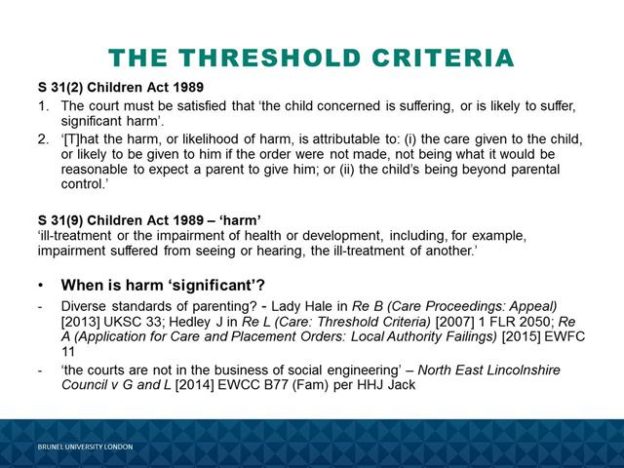
You will often hear the phrase ‘threshold criteria’ or ‘threshold analysis’ being used in care proceedings but unsurprisingly, anyone who isn’t a lawyer or social worker, often doesn’t understand what it means. In summary, the  ‘threshold criteria’ are the facts that a local authority have to prove if they want the court to make a care order or a supervision order.

The ‘Two Stage’ Test in care proceedings

In order to justify making a care or supervision order, the court has to satisfy a two stage test:

The first stagethe threshold stage – there must be sufficient reasons to justify making a care or supervision order – or in other words, the case must cross a threshold. This threshold can only be crossed if the court agrees:

  • that things have happened which have already caused significant harm to a child,
  • or pose a serious risk that significant harm will be suffered in the future,
  • or which show that the child is beyond parental control.

If the child is not suffering or at risk of suffering  significant harm there CANNOT be a care or supervision order. This is because the requirements of section 31(2)  of the Children Act 1989 will not be met.

The second stagethe welfare stage –  even if the threshold is crossed,  it must be in the child’s best interests to make an order. It is not inevitable that a care order will be made every time a child has suffered significant harm (but it is likely).

The importance of the ‘threshold criteria’

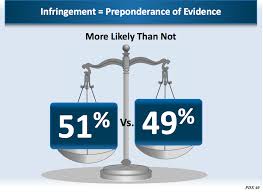
If you don’t cross the threshold, the court can’t make a care or supervision order. Therefore, the relevant facts must be proved on the balance of probabilities. If this isn’t done, the care proceedings have to stop. It is therefore vital to establish at a very early stage exactly what the LA want to rely on as their threshold criteria and to find out if the parents will agree or there needs to be a court hearing to test the local authority’s evidence.

The Court of Appeal restated the importance of this, in Re D (Threshold Findings and Final Orders at IRH) [2025] EWCA Civ 1362. The parents had stopped engaging and previous orders set out they were ‘deemed’ to have accepted threshold if they didn’t challenge it. Regardless, the Judge still needed to set out clearly what he found proved and he did not do this.

  1. There is no less a duty upon the judge to express clearly their findings and reasons if any of the parties (the parents in this instance) are absent from the hearing at which these crucial decisions are being made, even if absent by their own choosing. Moreover, it should be remembered that the child herself may as an adult wish to know more about the history of her childhood and early life, and in particular the reasons for her separation from her parents and the permanent severance of her family ties.  In this regard, it is distinctly possible that she will seek access to the judgment which gave effect to her permanent placement away from parents; if D were to read the judgment under review, she would I regret be left none the wiser.
  2. In circumstances such as these (i.e., at the conclusion of an IRH, on submissions only, where there has been no attendance of the respondent parents) there is no expectation that a judge will need to rehearse every argument or recite all the evidence; far from it.  Indeed, as Sir James Munby P observed in 2013, “it is not necessary” when the court concludes Part IV CA 1989 proceedings at any stage “for the court to find a mass of specific facts in order to arrive at a proper threshold finding” (View from the President’s Chambers: 2013).  But the judge in this case did not address any of the evidence in the case, nor did he even identify the alleged facts to support the threshold. There is no reference to the burden of proof.  There is no record of what he actually decided.  In this case the judge did not even append the statement of threshold facts to the order, contrary to common and expected practice.

The local authority will have to prove that things happened on or before the date they applied for a care or supervision order. It can rely on information that became available after that date, as long as it is information relevant to what was happening at that time. See R G (Care Proceedings: Threshold Conditions) [2001].

How is significant harm caused? 

  • EITHER by what the parents are doing or failing to do for their children (i.e. its more likely to be perceived as ‘their fault’)  
  • OR because the child is beyond parental control (which may not necessarily be considered the parents’ fault).  

See the case of WBC v A [2016] EWFC B70 in October 2016 where the court decided that there was no need to try and link a child being beyond parental control with anything that was the parents’ ‘fault’ – therefore threshold could be met on that basis without any need to ‘blame’ the parents. 

However, whether or not the parents are to ‘blame’ for what has happened to the children, there must be a clear link between the significant harm and the events on which the LA rely.

Lady Hale in the case of Re J [2013] UKSC 9 said:

Time and again, the cases have stressed that the threshold conditions are there to protect both the child and his family from unwarranted interference by the state. There must be a clearly established objective basis for such interference. Without it, there would be no “pressing social need” for the state to interfere in the family life enjoyed by the child and his parents which is protected by article 8 of the ECHR. Reasonable suspicion is a sufficient basis for the authorities to investigate and even to take interim protective measures, but it cannot be a sufficient basis for the long term intervention, frequently involving permanent placement outside the family, which is entailed in a care order.

The importance of clarity about the threshold criteria was restated in the case of Re D (A Child) [2025] EWCA Civ 1362 where a Judge made final orders regarding a 5 month old whose parents had stopped engaging with the proceedings and who had failed to provide any response to the LA threshold document. The Court of Appeal over turned this decision, emphasising that the court had to be satisfied that threshold was met and this could not be resolved administratively, the court must scrutinise the documents. The Judge needed to identify the threshold facts and refer to the burden of proof. The court suggested alternative wording to the standard orders

If the parents fail to respond [to the schedule of findings in support of the threshold criteria], the court may proceed to consider [at the next hearing / at the IRH / at the final hearing] whether the section 31(2) Children Act 1989 threshold criteria are established by reference to the written evidence filed by the local authority.”

What should the ‘threshold’ document contain? And when will I see it?

The local authority have to set out the proposed threshold in the application form for a care or supervision order. Some commentators have expressed concern that sometimes local authorities are not very good at setting this out clearly. See this post from Pink Tape. But hopefully parents will be able to get at least some idea of the case against them at the earliest stage.

Documents setting out the threshold criteria are meant to be quite short but will need to have enough detail to justify the proceedings and so the parents understand the case against them. The local authority will provide further evidence to support their threshold criteria with statements from social workers and other professionals such as teachers or doctors, depending on the facts of the particular case in front of them. But the threshold document should act as a clear and accessible summary of the problems and provide a quick ‘way in’ to understanding what the case is all about.

Sir James Munby, when President of the Family Division, discussed the format and length of the ‘threshold statement’ that a local authority must provide in 2013. (View from the President’s Chambers: the process of reform: the revised PLO and the local authority [2013] Fam Law 680). He states that the threshold document should be limited to no more than 2 pages and that the court does not need to find ‘a mass’ of specific facts to determine that threshold is crossed.  In asking the question – what does the court need? he answers:

It needs to know what the nature of the local authority case is; what the essential factual basis of the case is; what the evidence is upon which the local authority relies to establish its case; what the local authority is asking the court, and why.

The Court of Appeal endorsed this view in the case of Re J (A Child) [2015] and further endorsed the crucial importance of linking the facts relied upon with the requirements of section 31 of the Children Act 1989, which the President further discussed in the case of Re A (A Child) [2015].

Linking the alleged facts to the harm suffered, or likely to be suffered. 

For example: the LA might say:

‘The child has suffered significant emotional harm evidenced by:

  • frequent exposure to his parents arguing and fighting while he is present in the family home;
    • On at least two occasions in the past year the police were called by concerned neighbours when the parents were fighting (see police reports at pages XX of the bundle);
    • The police arrested the father who was drunk and had hit the mother in front of the child; the mother has refused to co-operate with the police with regard to any criminal proceedings against the father for assault.
  • The parents do not show any insight into their relationship difficulties and have refused to attend any counselling or domestic violence intervention programmes.

The paperwork before the Judge in a case like this is likely to contain, as well as statements from the social workers, parents and child’s guardian, evidence from the police, such as their own notes as to when they were called out and what happened, medical evidence to deal with alcohol misuse, possibly a report from a psychologist or psychiatrist. You can see why it is both helpful and necessary to put the issues in the case into one accessible document as even a simple case can generate a lot of written evidence.

If the parents can accept the threshold

The matter will then proceed to the ‘welfare stage’ i.e. where the Judge has to decide what if any order is right in this case. This will depend whether or not the parents have accepted they have difficulties and are willing to work at them. If so, no order or a supervision order may be appropriate. However, if the parents are found to have caused their child to suffer significant harm and do nothing to show how they will change for the future, or if the parents refuse to agree that there is anything wrong at all with their parenting, the court is likely to think a care order is the right order to make.

This will allow the LA to also have parental responsibility for the child and will put them in the driving seat with regard to making  decisions to safeguard the child’s future – which could include removing him to an adoptive or foster placement.

If the parents don’t accept the threshold

Then the Judge will need to read all the written evidence and hear oral evidence from everyone involved and then make a decision about what did or didn’t happen. Sometimes there has to be a separate court hearing to make a decision about an interim care order before the final hearing, but it is possible to wait until the final hearing to make a decision about threshold.

It is vital if parents don’t agree with the threshold criteria that they given their solicitors full information as soon as possible and produce their own written document in response.

What Judges have said about meeting threshold

The most significant case concerning threshold criteria is that of re B in the Supreme Court in 2013 which confirmed that a decision as to whether the threshold conditions for a care order have been satisfied depends on an evaluation of the facts of the case as found by the judge; it is not an exercise of discretion.

Lady Hale set out in paragraph 193 of her judgment in that case things that the courts should keep in mind when a threshold is in dispute:

  • The court’s task is not to improve on nature or even to secure that every child has a happy and fulfilled life, but to be satisfied that the statutory threshold has been crossed.
  • When deciding whether the threshold is crossed the court should identify, as precisely as possible, the nature of the harm which the child is suffering or is likely to suffer. This is particularly important where the child has not yet suffered any, or any significant, harm and where the harm which is feared is the impairment of intellectual, emotional, social or behavioural development.
  • Significant harm is harm which is “considerable, noteworthy or important”. The court should identify why and in what respects the harm is significant. Again, this may be particularly important where the harm in question is the impairment of intellectual, emotional, social or behavioural development which has not yet happened.
  • The harm has to be attributable to a lack, or likely lack, of reasonable parental care, not simply to the characters and personalities of both the child and her parents. So once again, the court should identify the respects in which parental care is falling, or is likely to fall, short of what it would be reasonable to expect.
  • Finally, where harm has not yet been suffered, the court must consider the degree of likelihood that it will be suffered in the future. This will entail considering the degree of likelihood that the parents’ future behaviour will amount to a lack of reasonable parental care. It will also entail considering the relationship between the significance of the harmed feared and the likelihood that it will occur. Simply to state that there is a “risk” is not enough. The court has to be satisfied, by relevant and sufficient evidence, that the harm is likely: see In re J [2013] 2 WLR 649.

Criticisms of the current approach to threshold – are too many cases going to court?

Isabelle Trowler. In her Bridget Lindley Memorial Lecture in March 2019 Care Proceedings in England: The Case for Clear Blue Water, raised a variety of concerns about what is beyond the recent and serious increase in number of cases coming to court.

She has seen the concept of ‘significant harm’ change and parents who would have once been described as ‘struggling in difficult circumstances’ are now accused of ‘neglect’. She found a lower – but inconsistent – tolerance for diverse standards of parenting with social workers becoming increasingly ‘pro child’, together with fears that the ‘march of predicative harm’ and the mis-use of section 20 has damaged relationships with parents and thus harmed the guiding force of the Children Act – that parents and professionals should work in partnership.  

Isabelle Trowler was concerned to note the proportion of children who ended up staying with their parents or within the wider family at the end of contested hearings – about a third. Although in the majority of cases intervention was necessary, if a child ended up with a Supervision Order – was it really necessary for that have gone to court?

But we found a very significant proportion of families subject to proceedings who ended up staying together – with 34 percent of all disposals resulting in a Supervision Order. The public purse pays a heavy price for taking families into court only for children to remain at home anyway; but families and their children pay the heaviest price of all. Inevitably, we had to question – was it really worth it?

The rise in the numbers of applications for care orders may be explained by the

…much greater and deliberate national focus on the early protection of the child, a stronger focus on lower level parenting concerns as first signs of cumulative neglect and with a recognised risk of future harm, a greater sense of urgency to act and secure permanency without delay and the need to act on the side of safety

She poses the worrying question – are we simply asking too much of parents now?

And it did raise an even more troubling question for me – are we asking the impossible of parents? We have an incredibly strong child focus and that is laudable – and that is something that we do not want to change – but in doing so have we made, inadvertently, the family the enemy? We have a multitude of professionals looking out for the rights of a child we have the local authority social worker and their supervisor and their manager, and then there is the foster carer, for example, and their supervising social worker and of course their manager. There is the independent reviewing officer and of course their manager. Then once we hit the court arena, we have the children’s guardian and then their supervisor and the entire hierarchy of Cafcass. That is a lot of people looking out for the child. Maybe as it should be. But is it fair? We are asking parents, often powerless anyway, often frightened and furious, to stand up to everyone else. This feels uncomfortable.

There is a need for some ‘clear blue water’ between those families who could continue to care for their children with help and support and those children who do need to be ‘rescued’ from situations that cannot or will not change within the child’s timescales. Lack of tolerance for diverse parenting standards, coupled with lack of resources appears to be creating a situation where the focus is on going to court.

But for the family justice system to work effectively and fairly, there should be clear blue water between those children who are brought into public care proceedings and other local children who have suffered significant harm or who are at risk of being so. But for there to be clear blue water between these two groups of families, this requires the local authority to be sufficiently equipped to support families and to manage the risk to children within their communities. This requires the right resource spent on the right things and a social work profession with the necessary knowledge and skill to practise confidently at all levels.

Further reading

  • Here is an interesting case which decided to what extent harm suffered by other children from a previous relationship could be relied upon to provide the threshold criteria for proceedings now.
  • Here is another case where the Judge considered threshold carefully and concluded that it was satisfied.
  • In this case the Judge decided that threshold was NOT met as the child’s injuries could have been caused by Vitamin D deficiency.
  • In this case, the judge was highly critical of the LA’s evidence, decided that threshold was not met and returned the child to his mother.
  • In this case, the President of the Family Division was appalled by the lack of any analysis by the LA of their case against a father; he found threshold was not met.
  • Neglect in the context of the criminal law – independent analysis and proposals for reform 2013

What do we mean by proving something ‘on the balance of probabilities’ ?


How and why do we have two different standards of proof in civil and criminal proceedings?

‘The balance of probabilities’ is the standard of proof used in all civil court proceedings, so includes care proceedings.

The other standard of proof we use is the one in criminal cases which is ‘beyond a reasonable doubt’ or that the jury must be ‘sure’ a crime was committed, which is a higher standard due to the very serious consequences that can follow a criminal conviction, such as loss of liberty.

Its often difficult for non lawyers to understand that there are two separate systems which work on two different ‘standards of proof’ and many parents struggle to accept that the lower civil standard of proof is used to make findings about parents which are often just as serious as a decision to send someone to prison. For example, the family court gets to decide whether a child is removed permanently from the parents’ care. This struggle becomes even more acute around the issue of removing children at risk of future emotional harm – i.e. for something that hasn’t happened yet, but the court thinks will.

I agree that if the State takes your child away, that is a very serious and significant interference in the family life of both parent and child. But if children are left in dangerous situations, that also puts them at serious risk of being hurt, either emotionally or physically. Therefore, it is a deliberate decision to use balance of probabilities in family cases because we could not always prove children were at risk using such a high standard of proof, or it may take much longer to find and gather together the evidence to have a court hearing, leaving the children at risk of harm while this is done.

Baker J discussed the issue of the burden and standard of proof in 2013:

In English law, the House of Lords has now concluded definitively that in order to determine whether an event has happened it has to be proved by the person making the allegation on the simple balance of probabilities. Where the law establishes a threshold based on likelihood, for example that a child is likely to suffer significant harm as a result of the care he or she would be likely to receive not being what it would be reasonable for a parent to give, the House of Lords has also concluded that such a likelihood, meaning a real possibility, can only be established on the basis of established facts proved on a balance of probabilities.

There are those who considered that to require the proof of past harm was a misreading of the intention of Parliament, and that a system devoted to child protection should not imposed such a high hurdle. It was argued, and in some quarters is still argued, that since we would not insist on proof before protecting our own children from risk, we should adopt the same cautious approach when protecting other, more vulnerable children. The House of Lords has of course firmly rejected that approach, which of course would at one extreme involve removing children from their parents on the basis of mere suspicion.

However, it is clear that certainly in ‘finely balanced cases’ that a finding can often be very difficult for parents to accept, particularly as any finding then becomes ‘the truth’ unless and until it is challenged. Our current system of fact finding permits only two outcomes (the ‘binary system’) – either it did or it didn’t happen.

Application of the standard of proof in care proceedings .

In care proceedings, the Judge has to be satisfied that the evidence to show that your child is suffering or is at risk of suffering significant harm has been proved on the balance of probabilities. This phrase has been explained to mean ‘more likely than not, or ‘ ‘more than 50/50’.

For a while, the courts did approach the standard of proof for serious allegations in  family cases as being similar to the standard in criminal cases, as it was felt that such serious allegations with such serious consequences required a high level of proof.

The courts however from 2004 onwards decided to move away from this approach and confirmed it by a decision in the House of Lords in 2008  (The House of Lords is now called the Supreme Court).

Baronness Hale said at paragraph 69 of her judgment:

There are some proceedings, though civil in form, whose nature is such that it is appropriate to apply the criminal standard of proof. Divorce proceedings in the olden days of the matrimonial “offence” may have been another example (see Bater v Bater [1951] P 35). But care proceedings are not of that nature. They are not there to punish or to deter anyone. The consequences of breaking a care order are not penal. Care proceedings are there to protect a child from harm. The consequences for the child of getting it wrong are equally serious either way.

Baronness Hale stated ‘loud and clear’ that the standard of proof in care proceedings is the simple balance of probabilities, neither more nor less.

Neither the seriousness of the allegation nor the seriousness of the consequences should make any difference to the standard of proof to be applied in determining the facts. The inherent probabilities are simply something to be taken into account, where relevant, in deciding where the truth lies. […] It may be unlikely that any person looking after a baby would take him by the wrist and swing him against the wall, causing multiple fractures and other injuries. But once the evidence is clear that that is indeed what has happened to the child, it ceases to be improbable. Some-one looking after the child at the relevant time must have done it. The inherent improbability of the event has no relevance to deciding who that was. The simple balance of probabilities test should be applied.

The dangers of ‘pseudo maths’ to determine the balance of probabilities

The court examined this in the tragic case of A (A child) 2018.  In November 2016 S, aged only 10 years, was found dead in her bedroom. Initially it was thought this was a tragic accident – that she had become entangled in decorative netting around her bed and injuries to her neck caused her death. There were problems at the outset in the police gathering evidence at the scene.

However it was then discovered she had injuries to her genitals, probably inflicted about 12 hours before she died and the view of the experts was that this made it more likely that the neck injuries were deliberately caused, probably in some sexually motivated homicide.

However at the first hearing the LA failed to persuade the Judge to make a finding on the balance of probabilities that both sets of injuries were deliberately inflicted. The LA appealed successfully to the Court of Appeal who criticised the first instance Judge for failing to look at the wide canvass of the evidence and to consider neck and genital injuries together, and also for attempting to apply ‘pseudo maths’ to the analysis of the balance of probabilities, in particular by identifying percentages for each possibility and adding them up. As the Judge could not reach ’51’ by this method, he concluded the LA had not met the standard of proof.

The Judge relied upon the decision of Mostyn J in A County Council v M & F [2011] EWHC 1804 (Fam), [2012] 2 FLR 939 as support for his contention that, where there are rival hypotheses, the judge is not bound to make a finding and that as a consequence the burden of proof is the only course to take. The judge went further saying at para 98 of his judgment that:

“98. I find that this is one of those unusual cases where the burden of proof comes to the judge’s rescue. Aggregating, as I must, the probability of suicide together with the probability of accident, I find that the aggregate of these two is more than 50 per cent. Doing the best that I can, I find that the possibility of suicide is about 10 per cent, and the possibility of accident and a perpetrated act are about 45 per cent each. It would be wrong for anyone to regard these figures as in any way accurate, for of course they are not. They persuade me, however, that the local authority has not discharged the burden of proof which is upon it. I am not satisfied, on the balance of probabilities, that this was a perpetrated act, albeit that I recognise that it is one of three possibilities. On the basis, however, that I do not discard the least probable and then allow a competition between the other two options, but that I should look at each of the alternative possibilities and aggregate them together, I am quite satisfied that the burden of proof in this case is not discharged. Accordingly, I do not find that the local authority’s case is proved in respect of any of the contested issues. By application of the binary principle, it is the finding of this court that neither the father, the mother, M or N are responsible for a sexual assault on L and nor are they responsible for her death. Accordingly, threshold is not met.”

The Court of Appeal firmly rejected this approach at para 51 of their judgment and emphasised that the starting point remains the test articulated in Re B (Minors) 2008 2 WLR 1 HL, discussed above:

“70. My Lords, for that reason I would go further and announce loud and clear that the standard of proof in finding the facts necessary to establish the threshold under section 31(2) or the welfare considerations in section 1 of the 1989 Act is the simple balance of probabilities, neither more nor less. Neither the seriousness of the allegation nor the seriousness of the consequences should make any difference to the standard of proof to be applied in determining the facts. The inherent probabilities are simply something to be taken into account, where relevant, in deciding where the truth lies.

Conclusions

It is the binary nature of our fact finding system that makes the ‘balance of probabilities’ sometimes an uneasy place to be. If the court finds something happened then that is ‘the truth’ that all must abide by for all future dealings with the family. If the court finds something didn’t happen then it simply never did. I am not alone in feeling uneasy about the consequences of this from findings made on the lower standard of proof, particularly when the fact finding exercise is offered as ‘the child’s right’ to know ‘the truth’ about what happened – See comment from the Justice Gap and  The Transparency Project in ‘further reading’ below.

However, what is clear is that the Judge must meticulously examine a broad canvass of evidence and not be swayed by any ‘pseudo mathematics’.  while I can sympathise with a Judge who attempts to impose some clarity on the analytical process by affording a ‘value’ to the options of suicide, accident, or deliberate killing, this is now clearly identified and rejected as unlawful.


Further Reading

  • There is an interesting article about the importance of ‘beyond reasonable doubt’ by BarristerBlogger;
  • Here is a useful  article by Simon Goddard which discusses in more detail the standard of proof generally, and with particular reference to cases involving suspected non – accidental injury.
  • We discuss how to get the best evidence to make the right decisions for children in our post ‘Achieving Best Evidence in Children Act cases’.
  • There is concern that the ‘balance of probabilities’ standard is structurally unfair – can a ‘fact’ really be found on 51% certainty? See this article from The Justice Gap, commenting on the tragic case of Poppi Worthington.
  • You can’t handle the truth – The Transparency Project, raises unease that more weight is being put on the balance of probabilities than it can reasonably carry.
  • Lucy Reed discusses on Pink Tape her unease that barristers facing a disciplinary charge benefit from ‘beyond reasonable doubt’ but parents will lose their children on the lesser civil standard.