Author Archives: Sarah Phillimore

Memoir of a Child in Care

On 30th January 2014, Jenny Molloy published her memoir ‘ Hackney Child: a True Story of Surviving Poverty and the Care System’. She describes her childhood of abuse and neglect and the reality of her life in the care system in the 1980s. She is still in touch with some of the social workers she met as a child, considering them ‘family’.

You can also visit her website 

Jenny Molloy was interviewed on Women’s Hour on Feburary 10 2014.

You can also visit Jenny’s Facebook page which has a lot of useful information and discussion.

For another view of life in care and serious concerns expressed about foster care, please read this article

Blogs from Birth Parents

We are very grateful to the birth parents who have agreed to share their stories with us. We hope that their insights and experiences will be valuable for everyone who works in or alongside the system.

Here you will find a blog from a birth parent who was not able to keep her child.

She agreed to share with us some of her experiences of losing her child.

I am 32, and my birth daughter, who is now 7, was adopted a year ago. She was taken into care after 3 reported incidences of being drunk in charge of a child. I got her home 6 months later, but then it happened again. She never spent another night in my care, or even another hour unsupervised in my company. I continued with drinking binges after she was removed, until I conceded defeat and that I couldn’t get well for her, that Social Services should do as they were planning, which was that for her own best interests she should be placed with adoptive parents. Each of the initial incidences was reported to Social Services by my family members.

I am an alcoholic. I never signed up for alcoholism, in my life as a single parent with a successful professional career. Alcoholism is no respecter of gender, ethnicity, social class, education level or religion. It affects the way that you think. You think it won’t be that bad. This time I’ll be able to stop. It’ll never really happen to me. I’m in control, I’m not that bad, I can still take care of my child, no-one will find out. Lies, all lies, to justify that the drink is ok, and pretend that it hasn’t taken that primary place in my life above my girl, my career, my health, my finances, my God, and my self respect. I couldn’t even stop for my beautiful, creative, loving, and very special daughter. It is a madness of the mind, the emotions, the body and most importantly the soul. This is what proves incontrovertibly to me that I had become powerless to stop in my own strength.

This is the worst grief I have ever experienced. I was 9 months sober by the time she was placed. I never stopped loving her, and I have never stopped missing her, and longing that things could have been different, that my recovery could have started sooner, that I could have been the best person for her to be with. I have had to admit that, for her own best interests, it was better for her to be adopted and settled with loving and secure parents, than remain in the care system in the hope that I got well. Except that then, I did get well, and have faced losing her, in sobriety.

If I want peace, for and within myself, I must learn to live with the inconsistencies of Social Services. I know many women who are alcoholics who have done what I did who still have their children, either because Social Services never found out, or because they decided that despite the problems the children were still better off with their parents than removed from them. When I am crying “it’s not fair” I am trying to wriggle out from what I have done – and what I have done is extremely wrong and damaging to a young child who was powerless to escape from it. Children cannot and should not have to wait until their parents get well. This is the spirit of the law in this area of child protection and it is true and it was true for my daughter. However I do want to also highlight that she never missed school, was always fed and clean and bathed and we read stories, we spent endless hours making things, and there had been no other concerns at any times, Social Services could find no emotional or psychological problems, apart from the normal distress caused by separation from her mother. There is an assumption that children who are removed are unclean, unfed, absent from school, and there are concerns from all who encounter them. Not always.

And I must grieve in silence and in private. The world does not want to hear of my grief, the primal wound that results from a mother forcibly separated from her child, because it is an unpleasant story, and I am the villain in it. And yet I must grieve. In the midst of all this, I am hurting and I have relinquished the way I had learned to cope with pain, in substances. I miss her and I love her and this hurts every part of me and some days I feel like it will consume me. I cry out to God that I am hurting and that I am grieving in the midst of terrible guilt and shame and I can’t sort all this mess out. This isn’t clean grief – having lost my mum almost 3 years ago, I know that grief too – but that is right, in the natural order of things, because children at some stage should lose their parents. My mum was young, but still, it is a clean and acceptable grief. For my daughter these feelings are complicated. I love my little girl, and I miss her with a pain that is physical, in the way it eats me up, she is lost and she is gone. I am joining one of society’s most unwanted and disliked groups, but giving this process a voice, to bring my shame and grief and hurt out of the dark where it cannot resolve, into the light might help someone else, perhaps who is facing this threat. And as I continue to cry out in pain, in prayer, for my daughter, that she will grow up loved, and if at all possible secure, and healed.

What do we mean by ‘significant harm’?


  • Your starting point in care proceedings is section 31 of the Children Act 1989. You can find the whole Act here or read what Wikipedia says about it.  
  • For more detail about this issue from the social worker’s perspective, please see this helpful article
  • For NSPCC Guidance on how to notice signs of abuse, see this document from December 2017 

Section 31 of the Children Act allows a Local Authority (LA) ‘or authorised person’ to apply to the court for an order which makes it lawful to to put a child in the care of a LA, or under the supervision of a LA. At the moment, the only other ‘authorised person’ is the NSPCC.

It is NOT the social worker who decides whether or not there should be a care or supervision order. This is a decision for the Judge or the magistrates. They are only allowed to make a care or supervision order if :

  • they are  satisfied there is evidence (‘threshold criteria’)
  • which proves on the balance of probabilities, that:
  • the child is suffering OR;
  • is likely to suffer significant harm in the future AND;
  • this significant harm will be a result of either ‘bad’ parenting – likely to be seen as the parents’ fault; OR
  • the child is beyond parental control – which may not necessarily be seen as the parents’ fault.

[For discussion about what is meant by ‘beyond parental control’ see the case of P (permission to withdraw care proceedings) [2016] EWFC B2.]

The ‘significant harm’ has got to relate to what the parents are doing or likely to do when they are caring for their child. The court will consider the standards of a ‘reasonable parent’: see Re A (A Child) [2015] EWFC 11 and  Re J (A Child) [2015] EWCA Civ 222.

In one case, LCC V AB and Others [2018] the LA and Guardian wanted to argue that the threshold regarding significant harm was crossed when a terminally ill mother wanted her children to go into foster care before she died; the court found that it was not and refused to make a care order. The Judge commented at para 26:

Recognising the difficulties she was going to face in her medical treatment and in her medical condition, she made, in my judgement, a timely request for alternate care.  In so doing, in my judgement, she acted as a perfectly reasonable, loving, caring mother and requested that the children be cared for by the local authority.  She has not subsequently wavered in her acceptance and understanding that the children should remain in full-time foster care, however much no doubt she would want to be looking after them herself.  She has cooperated at every stage with the local authority.  She has been a willing recipient of advice and support, as is exemplified, as I set out earlier in this judgment, with her acceptance of the advice about the frequency of overnight and weekend contact.

The court will look at two different issues:

  • how is the parent looking after the child? Is the kind of care they are giving the kind you would expect from a ‘reasonable parent’? or
  • Is the child out of control? for example, not going to school or running away from the parents and getting into trouble?

There is already quite a lot to unpick here.

  • What does ‘harm’ mean?
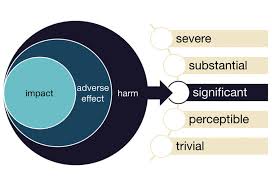
  • What does ‘significant’ mean?
  • What happens when the court is worried about risk of future harm?

What do we mean by ‘harm’ ?

Section 31(9) of the Children Act tells us that harm means:

  • ‘ill-treatment or the impairment of health or development including, for example, impairment suffered from seeing or hearing the ill-treatment of another’.

This last part about being exposed to someone else being badly treated, was added by the Adoption and Children Act of 2002. It is intended to cover such circumstances as a child who witnesses or hears someone else being hurt, for example if the parents are fighting or shouting at one another at home.

Development means ‘physical, intellectual, emotional, social or behavioural development’

Health means ‘physical or mental health’

Ill-treatment‘ includes sexual abuse and other forms of bad treatment which are not physical. This includes ’emotional harm’. This is the category of harm which probably cases most concern for a lot of people; they are concerned about what kinds of behaviour get put into this category. We will look at the issue of ’emotional harm’ more closely in another post.


What do we mean by ‘significant’ ?

Section 31(9) tells us what is meant by ‘harm’. But it doesn’t give a definition of what is meant by ‘significant’. The original guidance to the Children Act 1989, issued by the Department of Health,  stated that:

Minor shortcomings in health care or minor deficits in physical, psychological or social development should not require compulsory intervention unless cumulatively they are  having or are likely to have, serious and lasting effects on the child.

We can get further guidance from looking at Article 8 of the European Convention on Human Rights [ECHR]. Article 8 exists to protect our rights to a family and a private life. Article 8 makes it clear that the State can only interfere in family life when to do so is lawful, necessary and proportionate.

Proportionality is a key concept in family law. A one off incident – unless extremely serious, such as a physical attack or sexual assault – is unlikely to justify the making of a care order as the court would be unlikely to agree that a single incident would have long lasting and serious impact on a child. But the same type of incident, repeated over time may well have very serious consequences for the child.

Read Article 8 here. For further discussion about what is meant by proportionality, see our post here. 

There are some useful law reports where ‘significant harm’ has been discussed. For example, Baroness Hale stated in B (Children) [2008] UKHL 35:

20. Taking a child away from her family is a momentous step, not only for her, but for her whole family, and for the local authority which does so. In a totalitarian society, uniformity and conformity are valued. Hence the totalitarian state tries to separate the child from her family and mould her to its own design. Families in all their subversive variety are the breeding ground of diversity and individuality. In a free and democratic society we value diversity and individuality. Hence the family is given special protection in all the modern human rights instruments including the European Convention on Human Rights (art 8), the International Covenant on Civil and Political Rights (art 23) and throughout the United Nations Convention on the Rights of the Child. As Justice McReynolds famously said in Pierce v Society of Sisters 268 US 510 (1925), at 535, “The child is not the mere creature of the State”.

21. That is why the Review of Child Care Law (Department of Health and Social Security, 1985)) and the white paper, The Law on Child Care and Family Services (Cm 62, 1987), which led up to the Children Act 1989, rejected the suggestion that a child could be taken from her family whenever it would be better for her than not doing so. As the Review put it, “Only where their children are put at unacceptable risk should it be possible compulsorily to intervene. Once such a risk of harm has been shown, however, [the child’s] interests must clearly predominate” (para 2.13).

In 2013 the now Lady Hale stated in Re B (A child) 2013 UKSC 33

Significant harm is harm which is “considerable, noteworthy or important”. The court should identify why and in what respects the harm is significant. Again, this may be particularly important where the harm in question is the impairment of intellectual, emotional, social or behavioural development which has not yet happened.

The harm has to be attributable to a lack, or likely lack, of reasonable parental care, not simply to the characters and personalities of both the child and her parents. So once again, the court should identify the respects in which parental care is falling, or is likely to fall, short of what it would be reasonable to expect.

Sometimes, a lot of time is needed in care cases to argue about whether or not the harm in a particular case is serious enough to meet this statutory requirement. If the Judge decides there is no significant harm either being suffered now or likely to be suffered in the future, then he or she cannot make a care order or supervision order.

If he or she decides that there is enough evidence of significant harm, we move to the second stage of the necessary legal test – whether or not to make a care or supervision order is in the child’s best interests. This is called the ‘welfare stage’ of the test and we will examine this in another post.


Different types of abuse which can cause significant harm

In some cases it is very easy to see that a child has already suffered significant harm, for example when a child has been sexually abused or physically attacked. The court is likely to have clear and first hand evidence in the form of reports from doctors or the police who have examined or interviewed the child. The majority of people agree that being attacked or sexually abused is likely to be very harmful to children.

The more difficult cases involve issues of neglect and emotional abuse where it is hard to find one particular incident that makes people worried – rather it is the long term impact on the child of the same kind of harm continuing. These cases are particularly difficult when it is also clear that there are positives for the child in his or her family and the court has to decide whether the positive elements of family life are outweighed by the bad, or whether the family can make necessary changes quickly enough to meet the needs of the child.

For example, if on occasion you get angry with your child and shout at him or smack him it is highly unlikely your child would be considered at risk of significant harm if for the majority of the time you are loving and patient. But imagine a child who is shouted at and hit on a daily basis. It is not difficult to see how living in such an environment is likely to cause that child significant emotional or even physical harm.

See what the House of Commons Education Committee said about the child protection system in 2012.

Table 1: Children and young people subject to a Child Protection Plan, by category of abuse, years ending 31 March 2011

Category of abuse

2006

2007

2008

2009

2010

2011

Neglect

11,800

12,500

13,400

15,800

17,200

18,590

Physical abuse

3,600

3,500

3,400

4,400

4,700

4,820

Sexual abuse

2,300

2,000

2,000

2,000

2,200

2,370

Emotional abuse

6,000

7,100

7,900

9,100

11,400

11,420

Multiple

2,700

2,700

2,500

2,900

3,400

5,490

Total

26,400

27,900

29,200

34,100

39,100

42,690

More recent statistics from the NSPCC show neglect cases rising from 17,930 in 2013 to 24,590 in 2017; emotional abuse from 13,640 to 17,280.

You can see from the figures that the most common cause for concern about children in every year was the issue of neglect – but we can see a significant and consistent rise in number of cases of emotional abuse. The NSPCC confirmed that in 2015:

Neglect is the top reason why people contact the NSPCC Helpline with their concerns about a child’s safety or welfare – and this has been the case since 2006. In 2014–15 there were 17,602 contacts received by the NSPCC Helpline about neglect (3,019 advice calls and 14,583 referrals), an increase on the previous year13.

In 2012, the Education Committee examined the issue of neglect from paragraph 41 in their report and said:

41. Neglect is the most common form of child abuse in England. Yet it can be hard to pin down what is meant by the term. Professor Harriet Ward told us that, based on her research into what was known about neglect and emotional abuse, “we definitely have a problem with what constitutes neglect” and that “we need to know much more about what we actually mean when we say neglect”. Phillip Noyes of the NSPCC agreed that “There is a dilemma with professionals, and indeed the public, about what comprises neglect, what should be done and how we should do it”. He went on to explain his belief that: “at the heart of neglect […] is a lack or loss of empathy between the parent and child”.

42. There are two statutory definitions of neglect: one for criminal and one for civil purposes. Neglect is a criminal offence under the Children and Young Persons Act 1933 where it is defined as failure “to provide adequate food, clothing, medical aid or lodging for [a child], or if, having been unable otherwise to provide such food, clothing, medical aid or lodging, he has failed to take steps to procure it to be provided”. Action for Children has called for a review of this definition, declaring it “not fit for purpose” because of the focus on physical neglect rather than emotional or psychological maltreatment. Action for Children also believe that the definition leaves parents unclear about their responsibilities towards children and seeks only to punish parents after neglect has happened rather than trying to improve parenting.

[….]

The civil definition of neglect which is used in child and family law is set out in the Children Act 1989 as part of the test of ‘significant harm’ to a child. This is expanded upon in the previous Working Together statutory guidance which describes neglect as:

the persistent failure to meet a child’s basic physical and/or psychological needs, likely to result in the serious impairment of the child’s health or development. Neglect may occur during pregnancy as a result of maternal substance abuse. Once a child is born, neglect may involve a parent or carer failing to provide adequate food, clothing and shelter (including exclusion from home or abandonment); protect a child from physical and emotional harm or danger; ensure adequate supervision (including the use of inadequate care-givers); or ensure access to appropriate medical care or treatment. It may also include neglect of, or unresponsiveness to, a child’s basic emotional needs.

  • With regard to violence in the home between adults there is some useful information from the Royal College of Psychiatrists about the impact upon children of domestic violence here.
  • Read what we say about emotional abuse here.
  • Further information about the impact of neglect from research at Harvard University. 


Future risk of harm – what do we mean by ‘likely to suffer’ ?

Simply to state that there is a “risk” is not enough. The court has to be satisfied, by relevant and sufficient evidence, that the harm is likely

The most difficult cases of all are where a child hasn’t yet suffered any kind of harm but the court is very worried about the future risk of harm. It is this category which has caused most concern to those who worry about the child protection system as they feel strongly it is not fair to a parent to punish him or her by removing their child for something they haven’t yet done.

As Dr Claire Fenton-Glyn explained in her recent study on the law relating to child protection/adoption in the UK, presented to the European Parliament in June 2015:

A major problem with the law prior to 1989 was that it required proof of existing harm, based on the balance of probabilities. The local authority could not take a pre- emptive step to protect a child from apprehended harm, causing significant difficulties, in particular with newborn babies. As such, the inclusion in the Children Act of the future element of “is likely to suffer” was an important innovation, introduced to provide a remedy where the harm had not occurred but there were considerable future risks to the child. However, this has also been the cause of some controversy, as the answer as to whether a child will suffer harm in the future is necessarily an indeterminate and probabilistic one.

You can read about what the Supreme Court decided in a case like this in re B in 2013 where the court had to grapple with the issue of the risk to the child of future emotional harm.

Lady Hale said from para 193:

I agree entirely that it is the statute and the statute alone that the courts have to apply, and that judicial explanation or expansion is at best an imperfect guide. I agree also that parents, children and families are so infinitely various that the law must be flexible enough to cater for frailties as yet unimagined even by the most experienced family judge. Nevertheless, where the threshold is in dispute, courts might find it helpful to bear the following in mind:


(1) The court’s task is not to improve on nature or even to secure that every child has a happy and fulfilled life, but to be satisfied that the statutory threshold has been crossed.


(2) When deciding whether the threshold is crossed the court should identify, as precisely as possible, the nature of the harm which the child is suffering or is likely to suffer. This is particularly important where the child has not yet suffered any, or any significant, harm and where the harm which is feared is the impairment of intellectual, emotional, social or behavioural development.


(3) Significant harm is harm which is “considerable, noteworthy or important”. The court should identify why and in what respects the harm is significant. Again, this may be particularly important where the harm in question is the impairment of intellectual, emotional, social or behavioural development which has not yet happened.


(4) The harm has to be attributable to a lack, or likely lack, of reasonable parental care, not simply to the characters and personalities of both the child and her parents. So once again, the court should identify the respects in which parental care is falling, or is likely to fall, short of what it would be reasonable to expect.


(5) Finally, where harm has not yet been suffered, the court must consider the degree of likelihood that it will be suffered in the future. This will entail considering the degree of likelihood that the parents’ future behaviour will amount to a lack of reasonable parental care. It will also entail considering the relationship between the significance of the harmed feared and the likelihood that it will occur. Simply to state that there is a “risk” is not enough. The court has to be satisfied, by relevant and sufficient evidence, that the harm is likely: see In re J [2013] 2 WLR 649.

Therefore, if the court is worried about things that happened in the past and wants to use those events as a guide to future risk of harm, it must be clear about what has actually happened in the past – you cannot find a risk of significant harm based on just ‘suspicions’ about what might have happened before.

See further the Supreme Court decision of Re S -B [2009].

Baker J commented in 2013:

In English law, the House of Lords has now concluded definitively that in order to determine whether an event has happened it has to be proved by the person making the allegation on the simple balance of probabilities. Where the law establishes a threshold based on likelihood, for example that a child is likely to suffer significant harm as a result of the care he or she would be likely to receive not being what it would be reasonable for a parent to give, the House of Lords has also concluded that such a likelihood, meaning a real possibility, can only be established on the basis of established facts proved on a balance of probabilities.


Mythbusting – why is it important

The contributors to this site all have a lot of experience of the system, from many different perspectives. We agree that sometimes professionals can act in a way that isn’t professional and this has the potential to do a lot of damage and cause a lot of stress and fear. However it is very important to remember that there is no ‘conspiracy’ and we hope this site will help you understand why certain things might be happening to you and your family.

We have a whole page dedicated to   ‘common concerns we hear from parents’  which we hope will reassure you.

We also direct you to this very useful advice from the suesspiciousminds blog that a lot of parents have told us that they have found very helpful.


We accept the professionals involved may not always get things right….

Lawyers, Social Workers and doctors are after all just other human beings. And we all have good days and bad days, we can all make mistakes. The mistakes that the professionals make however do have the potential to cause enormous harm. So we need to look out for bad practice and deal with it.

Sometimes doctors don’t agree about the medical evidence. Sometimes it is very difficult to predict what people will do, as we can see from the Serious Case Review into the death of Mick Philpott’s children.

….but

what we don’t accept are the views of some that the whole system is just corrupt; that SW routinely lie to take babies away because they get cash bonuses paid for doing so. We don’t accept it is ever good advice to leave the country rather than work with Children’s Services.


What we hope to do here is set out some of the more commonly repeated ‘myths’ that we think do the most harm. We are always open to discussion about what should be included here or what you think is unfairly included here. We just ask that the discussion is polite and based on evidence, wherever possible.


What we think is really bad advice….

Again we re-direct you to the suesspiciousminds blog  who already has some really good advice on this subject.

However we do want to say that the most important thing you can do is work with social services and not against them.  There are a lot of scaremongers out there who will tell you differently but usually their advice (flee the country, refuse to work with social services etc) only makes things worse for you and your children. If in doubt for the best advice consult your legal team. They are not part of a conspiracy. Honest!

This is an example of a serious case review when things went very badly for a family because they did not want to work with Children’s Services:


And here are the views of one mother who went through the system and kept her child

These “theories”, the statements being bandied around as fact yet without evidence, the advice that is being given to flee, to run, not to work openly and honestly, not to seek help when it’s needed, to be coached to say the “right” thing, never to trust a system or it’s workers – it’s not helpful to us, it frightens us even more. We hear these statements and believe them – because we are threatened with losing the most precious thing to us. And in a lot of cases we believe them because it’s easier than confronting our own failings as parents.

Yes, there are mistakes and miscarriages of justice. Nobody denies that. And it’s abhorrent and I for one feel sick for those children and parents.

But they are in the minority. It just feels like they aren’t because the public is much more likely to hear about them via the media.

As I said upthread, ss took my baby at birth. I believed that to be the wrong thing for MY CHILD. So I contested their plan of “forced adoption” and – lo and behold – justice was done and – very very recently – I won. I was steadfast, I did not give up.

But – more importantly – I confronted the reasons why this was happening to my family. And I worked and worked and worked to repair the damage I had done. I educated myself on the law, I searched desperately for advice […] I eventually put together bits and pieces of advice, put my case together and fought. In my search I came across the Theorists. They absolutely terrified me. I took their advice on board – noting that the path of staying, confronting, fighting was the much more difficult option.

I can categorically say if I had taken the Theorists advice, I would have lost my baby forever.

Having the balls to stay, to fight, to work in partnership with the very people opposing me meant my baby and I are to be together.

Who should I trust? Advice from a family law barrister.

This is a guest post by family law barrister Lucy Read, who writes the Pink Tape blog.

Read a review of her book ‘Family Courts without a Lawyer’ here.


The importance of good advice

If social services are involved with your family or wanting to remove your children one thing you need is sound advice. There is lots of information out there on the internet, but not all advice is good advice, and general guidance does not always translate into a plan for what you should do in your own individual circumstances. Some things are universal but your family and your exact situation is unique.


The most important thing is to get information and advice before taking any rash actions. You don’t have to follow the advice you get, the decisions are up to you – but first listen to what people who know the system tell you.


If you are a parent and social services are talking about going to court or about removing your children you will be able to get free legal advice, and representation in court through legal aid – it doesn’t matter what your income is or how difficult your case is. If you are a family member such as a grandparent caring for a child you may also get free legal advice and representation – but this is generally not automatic and will depend on your finances and how strong your case is.


Most legal aid lawyers act for parents and children in these kinds of cases as their specialty. So they know a thing or two about what works and what doesn’t. If they advise you on a course of action think very carefully about what they are saying before disregarding it. If you don’t understand why they are advising you to do something – ask them. A good lawyer should explain why they are advising you to do or not to do something.


 Your lawyer acts for YOU and takes your instructions

Your lawyer is just that – your lawyer. They are independent of social services and will fight for you. But a part of their job is to advise you if something is hopeless or very unlikely to succeed, and to explain why pressing for a particular thing might make things worse. You need to know what your chances are before you go into court. So don’t be upset if they tell you something you don’t really want to hear – think seriously about what they say.


Your lawyer must act on your instructions though – so even if you decide not to accept their advice they will still argue your case for you. Do not worry that just because they have given you advice you don’t particularly like, or that you hope is overly pessimistic, that your lawyer is not on your side. They should be frank in private about your chances, but when in court or in negotiations will present your case and your arguments in the best light, putting forward the best points and challenging the evidence for you. They are used to having clients disagree with their advice, and will not be offended if you say you’d like to take a different course of action.


There are some restrictions on how far a lawyer can press a case for you – they can’t mislead the court by telling the judge something they know is not true, they can’t argue something that in their professional opinion is wrong in law or completely unarguable (they can still argue a weak case though), but it is ultimately up to them not you to decide how to run the case to give you the best chance of success – sometimes this means they won’t mention things that you think are important because they aren’t relevant or aren’t going to be as helpful as you think. But apart from those things your lawyer will run your case based on your instructions. If you think your lawyer is not doing this you can change your lawyer, but do think carefully about doing this because it can be difficult to get your legal aid transferred to a new lawyer’s firm and this can cause delay.


Most family lawyers are pretty good at what they do, but of course there are some that are not so good. It’s best to talk to your lawyer if you think they aren’t fighting your corner – they should be able to explain to you why they’ve adopted a particular approach in court, so it’s best to clear up any potential misunderstanding before rushing off to another lawyer.


Be wary of some sources of information

There is a lot of material out there on the internet about other people’s cases, some about cases which have gone wrong, or where social services have been criticized – some of it may be very frightening for you. You might feel like you should run away or that you shouldn’t trust social services. Don’t panic and take decisions based on what you read online – read it by all means, but ask your lawyer about it and how it applies to your case. And then, make your decisions.


Some information on the internet suggests that legal aid lawyers are “professional losers” who advise their clients not to oppose removal of their children, or who even agree to it without their clients instructions. It generally makes no difference to your lawyer financially whether you agree or don’t agree – there is no financial advantage in pressurising you to agree to settle something – a shorter hearing is usually paid less than a longer one. I’ve already explained that your representative must act on your instructions, even if they are foolish. It is your lawyers job to encourage you to make sensible decisions that are most likely to achieve your long term goal of keeping or getting back your children, but if you insist they must take the course of action you instruct. If they refuse to act on proper instructions your lawyer is committing professional misconduct and you can complain or change lawyer. I can’t say this never happens but in 11 years I have never been involved in a case where this has happened.


There is also some material on the internet and in the press that suggests or implies that there is a widespread corruption or conspiracy amongst social services or that social workers cook up allegations in order to snatch children from loving homes just so that they can be adopted, and that this is somehow for financial reward. I don’t think that is true, and the evidence for it is very weak : I think, based on my 11 years of experience of dealing with these cases and acting for parents, social services and children, that sometimes some social workers get things wrong, and sometimes some social workers make up lies or paint a misleading picture, and sometimes some social workers are too quick to suggest removal or adoption of children. Which is why you need a lawyer to guide you through the process. Ultimately you will have to make up your own mind about these sorts of things. Be sure to put yourself in a position where you have enough good quality information to assess those claims before jumping to conclusions or freaking out.


All family lawyers know that social services don’t always get things right, and they also know the best ways of demonstrating that to the court. But although you may not agree with everything social services say about you, usually there is some legitimate basis for their concern even if they have exaggerated or mixed things up or painted a misleading picture. You do need to address the points that they have got right rather than just deny everything.


Listen to what other people are worried about

Every case is different, but almost always your best chance of keeping your children or of getting them back is to listen to the concerns that are raised – really listen – think about whether the people raising those concerns might have a bit of a point, and think about what you can do to reassure people or to change things. It’s okay to say you’ve got things wrong in the past and that you haven’t been a perfect parent, but you do need to reassure people that things will be different in the future and show them why. It’s also okay to say that social services have got things wrong, but you’ll need to explain and show them where they’ve got it wrong. Burying your head in the sand, being angry or rude, or running away may make social services – and the court – more worried about how your children can be kept safe.


So. Listen to what social workers are saying even if you don’t agree with them. Get some legal advice and think about that advice before acting on it. Come to court and if you can, follow the advice of your lawyer about what you need to do at court and between court hearings, to give yourself the best possible chance. Base your actions on good information rather than on the advice of people who don’t know all the facts about your family or on your own emotions. And take responsibility for your own decisions.


Advice from birth parents

In this post, a number of birth parents share their views on how they made it through the stress of a child protection investigation and offer insights and advice to those in a similar position. Most of the contributors to this section have shared their stories on parenting forums such as www.mumsnet.co.uk

Relationships with Social Workers

It IS hard to see the wood for the trees, and I think one thing that Social Workers don’t seem to realise is that when you add in the stress of a CIN [Child in Need] case, where you are at risk of losing your DC’s, it puts so much added pressure on a parent that is already under pressure and a victim of DV [Domestic Violence] too, and often EA [Emotional Abuse] that they haven’t yet realised, that it becomes almost impossible for the parent to stop being fearful and stressed for ling enough to see the truth of their situation. I DO feel that a gentler approach from SS would actually in the majority of cases like the OP’s resolve the CIN concerns much faster.”

Need for clear communication about what is meant by ‘abuse’ and why it is harmful

Clearly setting out what constitutes EA [Emotional Abuse} and DV  [Domestic Violence] for the parent would open their eyes to things that they have often been minimising. With examples of each thing that can constitute abuse – including financial. Also stating clearly about the long term effects on a child of living in a DV situation, with possible issues it can cause for the children – NOT everyone knows this, it’s NOT taught about in schools.

Ask them to look at the list, and to answer it honestly, while the SW isn’t present, and going back for a second session with them, being clear about what they need done would also help.

It isn’t easy, as a parent who still loves their partner, to truly see an abusive situation for what it is. And it’s even less easy to know without being told, what you are meant to do to fix it.

It’s very easy for me now, as a 30-something adult, who has BEEN in a previous abusive relationship, to see what you are meant to do.

As a teenage parent, or a young parent, who has no experience of this, how in the name of hell are you meant to GUESS what you are meant to do??!!

And this is, I feel, where SS goes wrong, and stops putting the DC’s first. If SS were clear right from the beginning with handouts that explained everything that constitutes abuse, with examples, it would be far easier to spot when you are being abused. If they also gave clear directions on what is expected in that situation to protect the DC’s, many more DC’s would be protected from living in an environment with DV MUCH FASTER.

And parents who are in an abusive relationship would not feel so confused, fearful, and would be far less ‘obstructive’ in many cases, towards the SW’s attempts at helping.

It’s not always possible to find the time for navel gazing personal reflection to attempt to work out that you are in an abusive relationship andthat you need to get out of it pdq when you are actually coping with being in an abusive relationship, dealing with the day-to-day stuff that comes with having DC’s, AND are fearful of losing your children and not knowing why or how to fix it!

I think that a clearer picture from SS would actually PROTECT far more DC’s from living in a situation with abuse present.