Author Archives: Sarah Phillimore

Why does Everyone Hate the Family Court ? Part Four.

Heads You Lose: Tails You Lose

Sarah Phillimore writes:  I am grateful for this post from Emma Sutcliffe, part 4 in our series ‘why does everyone hate the family courts’?  Emma’s previous post on this topic can be found here.

The family justice system is very much in the public eye at the time of writing on May 15th 2019- 120 MPs have called for an inquiry into how the courts operate and The Victoria Derbyshire programme has hosted two discussions so far. It seems to be promoting the Women’s Aid line that the family courts ‘push contact with abusers at all costs’. I don’t think that is true.

But what I can’t deny is the level of fear, misery and misinformation around the family justice system and the fact that people often come out of it more brutalised than when they went in. What is the problem? How can we fix it? The only way I know how, having very little by way of political or media influence, is to continue to host these kind of discussions in the hope that somehow, some where a seed will be planted that may grow.

I don’t agree with everything that Emma says, I don’t agree the system is ‘set up against women’ . I am also concerned to see a picture painted of two parents – who presumably at one point loved each other enough to have children together – who now treat each other as bitter enemies. I don’t think the family court is responsible for that level of bad feeling, but I accept that as an arena it is the worst place to put frightened or angry people.

However, the point of this post is not to get Emma to agree with me or hound her for being ‘wrong’. The point is to identify where our perceptions differ and what shapes that. Is that divide a product of misunderstanding? Or some deeper ideological differences? Is the perception of parents’ clouded by their pain and misery? Or is my response foggy or jaded because of professional arrogance?

What should be happening here is the entirely sensible requirement when preparing for an adversarial environment, that you develop a theory of the case and you prepare your cross examination around that. A case with no strong narrative arc is messy and uncompelling. If the burden of proof is on you then a lack of focus on your theory of the case may be enough to sink you. What Emma describes here sounds to me like game playing of a much more cynical kind and verging on the unethical. Its not a tactic I ever employ or would ever advise. Once your life is being held up to microscopic examination in a court setting, then playing games should be the very last thing on your mind. 

However, this was Emma’s experience.  And, as she so powerfully says, no one should ever have to  ‘put on a performance’ to persuade a court to analyse the evidence before it and make a decision in the best interests of the child. Our courts should not be a theatre. If there is anything about the system and the people in it that encourages this – it needs to stop. 

How does a barrister prepare you to lose your children?

By roughing you over as if you’re a criminal. Family court is vilifying, humiliating and terrifying. It is worse when the narcissist you divorced is your opponent. Because the only person a narcissist loves is themselves and they’re quite prepared to lose whatever it takes in the process so that they don’t lose face. It’s called a ‘scorched earth policy’ and my barrister pummelled me in readiness of every court statement and appearance for the inevitable lies, fury and shouting that accompanies any head to head with someone who would even suggest their own children would be better in the care system than with their own mother.

The barrister who worked for me made me look straight on at the loss of my children and study assiduously both the recommendations of the court and the people who made the recommendations. ‘what’s the sound track in the court?’ He asked when we first met — some 16 hearings in by the point.

‘You are a bad parent’ he told me. Looking directly at me as he delivered a crushing home truth — “because just by even being in family court and having strangers decide how your children are going to play out their childhood you have let them down. In the eyes of the court therefore you are a bad parent”.

Am having got me to a state of despair he then sought to get me ‘judge ready’.

“This is the Anna* we need the judge to see — an exhausted, working mum who has been driven to seek to need the court’s help to deal with an utterly uncooperative parent. We need to mitigate risk to the judge — that you can accept your flaws but still do your best for the children. Let us let the baddest parent show themselves for what they are. Otherwise this just looks to the judge like two very clever people who are adept at arguing whilst their children look on. You need to accept and convey that you are contrite and remorseful that such behaviour has and would cause them emotional harm if it were to continue.”

And with that I had an epiphany.

Like it of not; family court is a game of chess. And the system is set up against women. Children are the sacrificial pawns and to win this game I had to have the agility of the Queen and read the board. The king appears to be the dominant player, but it’s the queen who can contort to whatever move is needed to protect and win the game.

And so, with that in mind I determined to adjust my mindset and moves. I could lose 50 percent of holiday time with my children for a few years until they get wise enough to reject their father’s bullying by themselves or I could dig my heels in, battle the court officers and keep portraying myself as a battling parent too determined to beat my ex than protect my children.

Thanks to that roughing over by the barrister the small lose or ultimate lose strategy was easy to shapeshift into.

Once he knew I understood the games and the rules, the barrister and my solicitor then crafted every statement and every question in every hearing thereafter to play to the soundtrack of the court — hardworking, long suffering caring mother, able to withstand every ludicrous allegation and still demonstrate cooperativity.

And as we walked into the final hearing — the narcissist did what narcissists ultimately do and lost it when he didn’t get exactly what he believed he was entitled to — adoration and dominance.

Judges do not like risk. And they do not like arrogance. They care not for how much money someone has, what car they drive, how well connected they are or if they are dressed in Armani or Primarni. They want to know that you show up, you accept help, you recognise your flaws and vulnerabilities and you put your children first. Game over. I lost the small battle.

The loss was wonderful because it was palatable. And in his summing up the judge adeptly dismissed every taunt, claim and even overuled his own biased officers. Furthermore he praised me for my courage under persistent sniper fire and concluded with words that were music — the music of the court — to my ears and to my children:

‘I cannot be confident that if residency were given to Dad that given the ludicrous allegations Mum has successfully defended Dad would not seek continued punishment of Mum using the children. Further time with dad risks psychological harm to the daughter. And without changes in the environment when a child is 12 they will start to vote with their feet and at this point it is Dad who risks losing the relationship without making changes. Given that the children are articulate, intelligent and clearly gifted, if they goose not to go to a parent’s house when they are 12 the court will not force the contact’.

The 24 months of worry that I would lose my children and my life was lifted during that 40 min judgment.

I had been judged.
My children had been heard and understood and our concerns justified.

There is no greater victory.
The loss that never ends — the loss of a meaningful loving relationships of trust, fairness, unselfishness and courage to give your children what they need — is the ultimate loss. I won the residency order. I won my children’s faith. The only loss I have is respect for their Father. That is the loss that knows no end.

Years later, however, I remain enraged about the performance I had to make to be ‘the exhausted, desperate Mum the judge needs to see’. I resent that my strengths — accuracy, challenging injustice, truthfulness and obstinance — qualities admired as ones of leadership in a man were instructed to be turned down because they are interpreted as non-compliant in a woman. We should speak up when something is not right, when undermining is taking place, when systems, people, Cafcass Officers are corrupt and corruptible. We tell our children to be brave, be bold, be yourself. Then we tell those girls who become women to stop these characteristics and accept the archetypes directed by our own Family Courts and the officials that turn the cogs.

The Cafcass Officer didn’t like my challenges. The psychologist accepted and praised my enquiring mind and described my ex for being fixed and resolute (uncooperative) whilst telling the court I held ‘the key to the resolution of the conflict — by backing down, shutting up, accepting the abuse persistently doled our through gaslighting, stonewalling and intransigence. I could flex and contort to any slight so the abuse could continue unchecked if I wanted residency of my children. Three different judges wanted or saw three different ‘Anna’s’ — one saw a frustrated mum, one only saw a mum with anxiety and hurried me out of his court, one saw why I was ‘challenging’ and that my ability withstand years of abuse and coercive control transacted through my children was attributable to my being bold, brave, myself.

The Barrister did what he had to do to get me the right result for the misogyny of the family court with officers and paid-for experts waiting to point their fingers and say ‘difficult woman, difficult woman’.

Because challenging women challenge them and their infrastructures, assessments and belittling of women.

So I’m here. And I’m ready to fight back for all those women who don’t have my strength or have had their resilience worn away by the family courts. It is time for change.

https://twitter.com/SVPhillimore/status/1129118565876097035

Fabricated and Induced Illness

This is a post by Sarah Phillimore. I was recently alerted to a Radio 5 Live Investigation into ‘Fabricated and Induced Illness’ [FII] in May 2019. I think this is a useful opportunity to explore FII in more detail for readers of this site. 

https://twitter.com/MumScots/status/1124948692606304256

The history of Fabricated and Induced Illness [FII]

Concerns that parents may exaggerate or even cause their children’s symptoms of illness have been around for a long time. It used to come with the flowery title ‘Munchausens Syndrome by Proxy’, from the fictional character Baron Munchausen who told outrageous lies about his non existent achievements.

Obviously, this description was confusing to many parents and professionals, as well as wrongly giving the impression that it was a psychiatric condition in its own right. As Kate Grieve commented in 2015, the case of R v LM [2004] QCA 192 at para. 67 (4 June 2004)  in the Supreme Court of Queensland, Australia, held that “the term factitious disorder (Munchausen’s Syndrome) by proxy is merely descriptive of a behaviour, not a psychiatrically identifiable illness or condition”. She further comments:

FII is not a mental illness as can be diagnosed. Perpetrators will have various psychological, psychiatric, and environmental features leading to the behaviour of fabricating or inducing illness in a child. FII is a form of child abuse where the perpetrator uses medical professionals as tools to subject the child to harm.

The Royal College of Paediatrics and Child Health of 2021 (see further reading below) refers to 3 different terminologies:

Medically Unexplained Symptoms (MUS) –  a child’s symptoms, of which the child complains and which are presumed to be genuinely experienced, are not fully explained by any known pathology. The symptoms are likely based on underlying factors in the child (usually of a psychosocial nature) and this is acknowledged by both clinicians and parents. MUS can also be described as ‘functional disorders’ and are abnormal bodily sensations which cause pain and disability by affecting the normal functioning of the body. The health professionals and parents work collaboratively to achieve evidence-based therapeutic work in the best interests of the child or young person.

Perplexing Presentations (PP) – a term introduced to describe the commonly encountered situation when there are alerting signs of possible FII (not yet amounting to likely or actual significant harm1), when the actual state of the child’s physical, mental health and neurodevelopment is not yet clear, but there is no perceived risk of immediate serious harm to the child’s physical health or life. The essence of alerting signs is the presence of discrepancies between reports, presentations of the child and independent observations of the child, implausible descriptions and unexplained findings or parental behaviour. 3.2.3

Fabricated or Induced Illness (FII) – a clinical situation in which a child is, or is very likely to be, harmed due to parent(s) behaviour and action, carried out in order to convince doctors that the child’s state of physical and/or mental health and neurodevelopment is impaired (or more impaired than is actually the case). FII results in physical and emotional abuse and neglect, as a result of parental actions, behaviours or beliefs and from doctors’ responses to these. The parent does not necessarily intend to deceive, and their motivations may not be initially evident. It is important to distinguish the relationship between FII and physical abuse / non-accidental injury (NAI). In practice, illness induction is a form of physical abuse (and in Working Together to Safeguard Children, fabrication of symptoms or deliberate induction of illness in a child is included under Physical Abuse17). In order for this physical abuse to be considered under FII, evidence will be required that the parent’s motivation for harming the child is to convince doctors about the purported illness in the child and whether or not there are recurrent presentations to health and other professionals. This particularly applies in cases of suffocation or poisoning.

The NHS describe it in this way.

FII covers a wide range of symptoms and behaviours involving parents seeking healthcare for a child. This ranges from extreme neglect (failing to seek medical care) to induced illness.

Behaviours in FII include a mother or other carer who:

  • persuades healthcare professionals that their child is ill when they’re perfectly healthy
  • exaggerates or lies about their child’s symptoms
  • manipulates test results to suggest the presence of illness – for example, by putting glucose in urine samples to suggest the child has diabetes
  • deliberately induces symptoms of illness – for example, by poisoning her child with unnecessary medication or other substances

How widespread is FII?

FII It is undoubtedly a ‘real thing’ and can cause serious harm to children as well as a massive drain on NHS resources. But it is also a rare thing – it is difficult to estimate with certainty how many cases arise each year, but some estimate about 50. The NHS refer to one study which published in 2000 which estimated 89 cases of FII in a population of 100,000 over a two-year period. However, they believe this figure is a likely under-estimate of the actual number of cases.

Taking a figure of 50 per year, is on a par with statistics around children who are murdered; 330 children were killed between 2009 to 2015  i.e. about 47 per year. Compare this with road traffic accidents  – in 2011, 2,412 children aged 0-15 years were killed or seriously injured on Britain’s roads. So about 7 children a day will die or be badly hurt on the roads as opposed to less than 1 a week being victim to FII.

Fiightback told Radio 5 Live that they had about 600 people seeking their support and 70% had been ‘cleared’. They had attempted FOI requests from LA to be told that no data was held about numbers of FII cases.

Concerns that cases of FII are rising

The group “Fiightback” was set up “to support those accused of FII, to fight for an unbaised criteria, a fair investigation and a pathway to rebuild the lives of those wrongly accused”. It shared with the BBC their worries about a ‘wave of false allegations’ of FII.

It now wants a review into the number of FII child protection investigations like Amy’s, as well as the FII guidelines for medical and social work staff.

It also wants national and local policy on responses to accusations of FII to be looked at, and new standards set.

Carol Monaghan MP – who has led calls in Parliament to raise awareness of FII – said she would support an inquiry.

She added: “Disturbingly, diagnoses can be made by health professionals who have not met or examined the child, and child protection procedures can then be instigated as a result of a remote diagnosis.”

I can’t comment on the statistics that inform that comment about ‘wave of false allegations’ because I don’t know them. I can’t find any references on the Fiightback website. All I can say that in my practice spanning 20 years I have only been instructed to act in a handful of FII cases. I have not encountered in the past few years any noticeable increase. And I would be very troubled if diagnosis of any medical condition was attempted by any doctor who had not actually met the child – unless this was a court authorised review of medical records collected by other doctors for e.g.

But if such concerns are raised, then it is right that they are properly investigated and we have clear evidence to either support or deny them. A suggestion was made in 2018 that such cases are on the rise because local authorities want to avoid paying for services – that is an extremely serious situation, if true. Andy Bilson commented to Radio 5 Live that the definition of FII appeared to be widening in some areas to include parents who ‘genuinely’ believed their child was ill – thus bringing into the net of suspicion those parents seeking services for their children.

Efficient and speedy investigation is needed.

FII brings the ‘perfect storm’ for a family justice system, already prone to risk averse decision making. FII represents something that doesn’t happen often, but when it does the consequences for child could be catastrophic. Little wonder then that many professionals may act defensively.

And of course, professionals are fallible. A decision made hastily to separate parents and child may turn out, after proper investigation to have been the wrong decision, based on imperfect understanding of the medical evidence as it initially presented. The Websters for example, whose child’s broken bones were caused by scurvy, rather than deliberate infliction of force. Sally Clark, who was convicted of murder on the failure of Professor Sir Roy Meadows to understand and apply statistics correctly.

We need a clear idea about how many cases there are and how many do not result in any findings against the parent – as the impact of such cases can be devastating if no findings are made. Amy, the mother interviewed by BBC Five Live commented :

I felt like my character was assassinated, my family was ripped apart and my child was stolen

So how do we manage these cases?

Few would disagree that if a competent medical practitioner raises a concern that a child is being hurt by a parent, that this needs to be investigated and the child kept safe while the investigation is carried out. The problem of course is that this investigation can often take many months or even years and throughout that time the child is likely to be living separately from his parents, although hopefully still having regular contact.

The key therefore must be to make sure investigations are carried out as efficiently and quickly as possible.  The NHS guidance for medical professions highlights the necessary steps.

  • Its important to have a senior paediatrician to carry out an overview of the case and to seek further specialist advice or testing if needed.
  • A detailed chronology must be written of all the available information related to the child’s medical history. 
  • Doctors must contact the relevant child protection team of the local authority’s children’s services to inform them of the concerns.
  • Other agencies involved with the child’s welfare, may be contacted in case they have information that’s relevant such as the child being absent from school.
  • The police will also need to be informed and all professionals must meet to discuss the best way to proceed with the case.
  • Covert (secret) video surveillance may be used to collect evidence that can help to confirm a suspected case of FII but this will require proper authorisation and is rare in practice as usually the parent will not be allowed unsupervised access to a child once concerns about FII are raised.  For a discussion about surveillance of families by social workers, see this post from Pink Tape. 

The LA will usually start care proceedings immediately and seek separation of child and parent, unless there are other family members who can help to provide constant supervision.  There may well be parallel police and care proceedings – while care proceedings should never ‘wait’ for criminal proceedings to get started or conclude, it is clear that if a live police investigation is also on going, this has the potential to cause delay.

As ever the focus must be on the evidence – what is needed, who is best person to provide it, and how should it be tested. This are not easy cases and will require more than most continuity of Judge and lawyers.

Further Reading

Re X, Y and Z (Children) [2010] EWHC – Application by local authority to withdraw from proceedings, under FPR r 4.5, for interim care of three children. Local authority ordered to contribute to the costs of the parents.

Concerns over Fake Illness Cases in Troubled GOSH department – April 2018 Melanie Newman

Safeguarding children in whom illness is fabricated or induced – 2008 Statutory guidance from Department of Education, on protecting children where carers or parents make a child ill or pretend a child is ill.

Regional Child Protection procedures for West Midlands – guidance on FII 2017

Achieving Best Evidence in Children Act cases. 

Guidance from the Royal College of Paediatrics and Child Health February 2021

BR and others (Three Families: Fabricated or Induced Illness: Findings of Fact) 2023 High Court Judgment Template

In the matter of: Re N (Children: Fact Finding – Perplexing Presentation/Fabricated or Induced Illness) [2024]

The State versus the family: does the Government no longer trust parents?

This is a post by Sarah Philimore

I was really pleased to attend the Tortoise ThinkIn in London on May 1st. The aim of Tortoise is to ‘flesh out’ how to take reporting forward. A ThinkIn is a system of organised listening, a forum for civilised disagreement and the ‘engine of our journalism’.

Polly Curtis, the journalist who has already written examining in depth the child protection system, and James Harding, the co-founder of Tortoise and former Editor of The Times, chaired the discussion. It is not difficult to see why they are interested in understanding more about the child protection system; many are seriously concerned at where we now find ourselves. As Polly commented in her article ‘The Poor Parents’:

These are the numbers: by the time they reach their fifth birthday, nearly one in five children have been referred to social workers. The number in care has peaked at 75,000 – the highest level since records began in 1994. The system designed to keep our children safe is creaking under its caseload.

So what is going on? Opening the floor to those who are ‘really thinking’ about the issues – regardless of their backgrounds and experience,  may open up a different perspective and increase the understanding of even the most specialist participant.

Defensive practice

The starting question asked  –  what are the drivers to this huge increase in care proceedings? Andy Bilson made the point that there are drivers both inside and outside the system. Outside we see the cuts in services, poverty and deprivation. You are ten times more likely to be in care if you fall within the bottom 10% of the most deprived in the population. Then there are the drivers within the system; defensive social work practice and risk aversion. He noted that before their 5th birthday 1 child in 16 would be investigated for risk of abuse; in 66% of cases no abuse is found. There is no evidence that the current child protection system works. Social work itself has changed.

We circled back to this point with a variety of speakers. One made the very powerful point that we were seeing ‘assessment without action’. Box ticking was a way for social workers to guard against criticism but the work had no purpose.

So why are social workers so defensive? I was very glad to hear James Harding admit that he had felt ‘uncomfortable’ for much of the discussion, recalling the role he had played as a journalist in shaping the narrative around child protection issues; a focus on ‘single issues’ that then translated to political culture.

We could all see the spike on the graph after2007 and the media storm around the death of Peter Connolly. As one speaker commented, as a society we have a collective responsibility for how social workers behave – if they are to be subjected to death threats for not intervening and a child dies, then do not be amazed if a decade later we are seeing the ripple effect of that defensive culture still in operation.

But as James commented – it is easy to show what you are against, rather harder to show what you are for.  How do we create an agenda to create change?


Timescales

There was much talk about ‘timescales’. Clarissa, a parent whose children have been adopted said how much she hated the word as she heard it all the time. She was told to write a letter to her children apologising for ‘not making changes’ ‘within their timescales’ – changes she said she did not know how to make. Alice Twaite of The Transparency Project commented that access to knowledge comes too late; legal aid provision is skewed to the very end of the process where the 26 week timescales for care proceedings may mean it is impossible for parents to access the therapy or support they need to show that they can turn things around. I commented that the apparent rigidity of the 26 weeks caused me concern; not least because I saw real fear and unease in court at times when Judges commented that they had to keep the case ‘on track’ or risk ‘their stats’ being scrutinised.

But of course, the response to that is that 6 months is a long time if you are a baby – its possibly your entire life.  The neurological evidence seemed clear – the impact of abuse and neglect on young children was very serious. We had to move quickly to prevent children becoming very seriously damaged. Polly commented that this would be a fruitful area of further investigation as something substantial that can be measured.

What is our narrative?

There were so many other points made of interest that it would take a blog post of many thousand of words to cover it all. I have tried here to highlight what resonated most for me. What I find most compelling is the intersection of the various narratives. What ‘story’ do we want to tell, and why?  Is it about the child who needs ‘rescuing’ from the dangerous home? Is about the mother like Clarissa who sees her children once a year and counts herself ‘lucky’ to do so; she grieves every birthday, every Christmas.  Is it about austerity and cuts and lack of services? Is it about distrust and blame and fear?

Its all of these of course. And that has been the challenge for journalists over the years. To take these many and unweilding narratives and from that find a story that the public want to read. When the family courts are closed and secretive, journalists will fill the gaps in their knowledge with the sensationalised. The challenge is now upon us all to investigate openly and honestly. As Alice Twaite pointed out; journalists need to take care with their narratives. If there is a published judgment where findings of fact have already been made, those cannot be skated over in favour of a more lurid and clickbait worthy narrative from a parent who may not have an incentive to reveal all the necessary detail.

I have been – rightly I think – very critical of journalists in the past and I think the negative legacy from their reporting of the deaths of Peter Connolly and Victoria Climbie is with us still. But many of us ‘in the system’ have not helped the wider public to understand, indeed many still cleave to ‘privacy’ as some strange badge of  honour.

I do not know what we need to do to turn this ship around. And I appreciate that constant talking around a problem can appear nothing more than an indulgent waste of time. But this felt different. Since 2015 and the first CPConference. I had often felt despair about how the willingness to engage in talking would ever translate into action.  But finally now, it seems as if something is happening. Parent advocacy groups are springing up around the country, Louise Tickle continues with her Open Family Court project – and Tortoise shows that there is appetite for a different kind of journalism that may finally give children and families the examination of their narratives that they deserve.


Do we make unnecessary use of care proceedings?

This is a post by Sarah Phillimore.

This is the text of a talk I gave at the Bristol Civil Justice Centre on April 15th 2019 as part of a debate entitled ‘We make unnecessary use of care proceedings’. 

The situation regarding care proceedings in England and Wales is dire. There are various reports and worries about the ever increasing number of care proceedings with no corresponding increase in identification of those children who actually suffer harm. The worry from many is that we have created a voracious and possibly unstoppable  ‘risk monster’

EDIT – that line should read ‘ever increasing number of section 47 investigations’ rather than care proceedings. 

Various senior Judges have warned that the family justice system is close to collapse and cannot sustain this continuing increase in numbers of applications for care orders.

Much of the discussion on and off line from parents and some professionals is in very bleak terms about the sustainability of the system and the harm that it does to those who come within it.  Richard Devine commented on Twitter in March 2019:

Sometimes I wonder, in 50 years time, what aspect of the current child protection system will, with retrospection, seem incomprehensible, unethical, absurd?

The answer came swiftly from one Twitter user:

Most of it. Its harms to health, mental health and human well being will be evident and regrettable.

This is a fairly typical exchange. So I can immediately see and understand that the easy and obvious answer to this question is ‘yes’. But, as ever, I think the answer is a more complicated than the question poses at face value. And that’s why I wanted to speak against this motion. Not because I have any naive hopes that my mere rhetoric will sway anyone from their decided view. But in the hopes that you might at least listen and think about some of what I say.

All care proceedings involve failure.

All care proceedings involve failure. It is a failure of at least one of the following 3 things; the very worst cases are a failure of all 3.

  • A failure by parents to reach ‘good enough’ standard in their parenting, a failure so serious that it either causes their children significant harm or puts them at serious risk of the same. The degree of blame to be attached to this can vary from ‘none at all’ for those parents with disabilities who did their best, to a very high level of culpability which finds the parent also facing criminal proceedings, for example due to sexual assault or deliberate infliction of physical harm
  • A failure by social workers or other professionals to build a relationship pf trust with a parent who is struggling. Or worse than that, professionals who operate from untested assumption and prejudice. Or worse still, professionals who actively mislead by altering documents or lying to the court. I hope that latter example is a very small minority but I accept that even one case a year is one too many
  • A failure by the State to provide any sufficient safety net for parents and professionals who are struggling. A failure to provide and maintain support for those with poor housing, mental health struggles etc. A failure to provide safe working environments for professionals, allowing case loads to rise beyond what is sustainable or safe.

Once the case then comes to court, The court system itself often fails to deliver what we know is needed. The procedure is often not quick, efficient or humane. This puts at risk the need to have the right decisions made on the right evidence, which in turn puts in peril the child’s need to have the right placement and the right support identified and provided.  Parents are left behind at the end of it, confused, miserable and alone with no further legal support to challenge a decision they may feel is profoundly wrong.

The whole system is predicated on failures. Some of those failures are a shameful indictment of the way our society operates. Other failures are simply a reflection of the inherent frailty of human beings. We could only eradicate those types of failures by going down a road of eugenics and social engineering which only a fanatical and dangerous few would ever advocate.

Because a system ‘fails’ does that make it unnecessary?

I would like to conduct a quick and unscientific poll.

Children are vulnerable. Not all parents can be good enough parents. This isn’t about moral blame. Its about asking hard questions about what we, collectively, agree we should do to protect the most vulnerable members of our society.

  • Who in this room thinks that children aren’t at risk of death or serious harm from their parents? Raise your hand.  31 children under 16 were killed by their parents in England and Wales in 2015 – three a month – compared with 23 in 2014. 
  • Of course, deliberate murder is thankfully rare. But who in this room thinks that the State should step in to protect only those children at risk of being murdered? Raise your hand.
  • Who in this room thinks that the State should step in to protect only those children at risk of having their bones broken? Raise your hand.
  • Who in this room believes that from the age, say of 0-12 years only a parent can have any authority over the education and health care received by their child? Raise your hand. 

Unless ALL or NONE of the hands go up in answer to the last 3 questions, then we have to accept that there is room for disagreement about exactly where the line should be drawn – but the one thing I think we would all agree with – there is a line, somewhere.

EDIT – NO hands were raised. On reflection, it would have been more interesting to ask a question about the more nebulous aspects of threshold, such as emotional abuse. But it was clear that all in the room agreed that children need protection from dangerous parenting. 

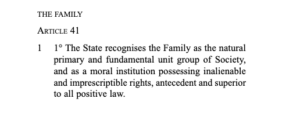
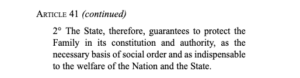
The journalist Louise Tickle visited Dublin recently and discussed her visit on her Open Family Court website. She made the point that the importance of the family is set out explicitly in the Irish Constitution


This is reflected in many other international and domestic laws and practices. But it cuts both ways doesn’t it? If you are expecting the State to step in and defend the family as a ‘necessary basis’ of social order and ‘indispensable’ to the welfare of an entire nation, then presumably the State must have something to say about those individuals who threaten the sanctity of the family by harming members of it?

Its interesting to note what else Louise Tickle observed. One of the benefits of Ireland’s Child Care Law Reporting Project was that not only did it act to permit scrutiny of state action in interfering with families, it also allowed the public to see just how bad things could get for children

McKittrick also believes that reporting has raised society’s awareness of and sensitivity to child abuse. “Our perception is that the general public have had no idea of the level of misery that these children experience, and we can’t talk about it,” she said.

Conclusions

So no, I don’t believe that we make ‘unnecessary’ use of care proceedings. I do however think that the outcome of these proceedings is moving ever further away from what was hoped for by those who framed the Children Act. We have essentially betrayed the legacy of the Children Act 1989 by removing funding for the support services so essential to its proper operation.

As Professor Jo Delahunty QC commented after her recent lecture to commemorate its 30th birthday

The lack of financial support for community resources [and the] the rise in [applications under] s 31, they are linked. Hence the value in reminding the audience of how the Act was meant to cover community as well as court procedures with access to services, advice and support being embraced within its composite parts . However with limited legal aid for pre proceedings advice for parents , S 20 abuses , legal aid deserts for early (any!) advice in private law , court staff / judges acting as advisors and counsellors and lack of court time as we have judges working to break point: all these deficits are crippling.

Community lack of access to services and legal advice compounds an overwhelmed and overwhelming social care environment staffed by disrespected social workers , often unsupported , and inadequate managerial oversight with little joined up thinking with legal departments. I think every strand is intertwined.

Hence why I thought a reminder of what we should strive at might be timely.

Further reading

Thread of live tweets from the night #FCDebate

Children Act ‘betrayed’ in climate of cuts 16th April 2019 Community Care

You never lose the fear of the knock on the door April 2019 Tortoise Media

Care Proceedings in England: The Case for Clear Blue Water March 2019 Isabelle Trowler


Mums on the run: When you have tried everything else you have nothing else to lose

This is a post by Sarah Phillimore.

On April 4th BBC’s Woman’s Hour discussed the issue of mothers who repeatedly lose their children into the care system and the decision made by some to ‘flee’ the jurisdiction, sometimes with the financial and emotional support of an organised network of people.

This prompted some further discussion online. I have already written in some considerable detail about the issues that arise from this; see the posts set out in Further Reading below.

The conversation on line was very useful for clarifying some thoughts and questions about where we go from here.

A typical reaction to hearing the story of ‘Zara’ on the Woman’s Hour podcast was of shock and sadness. Why should any mother have to go through this? Just what is the scale of the problem and what can we do about it?

A number of parents asserted to me that ‘lots’ or ‘the majority’ of parents who left the UK ‘settled well’. I pressed them to help me understand what actual numbers informed this statement – and what happened to the minority who did not settle? The parents were not able to answer and seemed to find my questions an attack on their integrity and intelligence, which I did not understand. I was asking for the raw data that informed their confident assertions. After a few hours of such to and fro it became clear that no one knows the numbers. And that has been the primary issue that causes me concern about all of this.

One person provided screen shots of a group operating in Egypt which explained to parents

…. remember summer is blisteringly hot here. Not like a summer holiday. We want only mums who will fight to the end whatever the conditions to protect their child… medication to cope with withdrawal from drugs we can get… (winking face emoji)

Even that brief description suggests the risks to parents and children, many already vulnerable, are huge. Rather chillingly, one parent commented:

Genuine neglect, abuse and incapability cases never survive long… unless you can survive for 6 months with no income, don’t bother…

Those who offer money to send people out of the jurisdiction appear to undertake no risk assessment, keep no records and don’t record the progress abroad of the fleeing parents. We urgently need to understand the scale of the problem.  The ‘fight’ rhetoric is worrying and will obviously be appealing to desperate parents. As one commented via Twitter

And they wonder why we run when you have tried everything else – you have noting to lose

What is the scale of this problem?

One parent (who had left the jurisdiction and was now parenting her two youngest children, despite losing the older ones to the care system) suggested that about 50 parents ‘on average’ left the jurisdiction.  One parent wondered if a higher number of parents who already had dual nationality would leave the jurisdiction – but that, interestingly has not been my experience.

One person commented that the following three questions need to be asked

a) Why do parents flee

b) why do other countries not consider the same parents to be a danger to children?

c) what the hell is going on?

I think these are all essential questions to be answered. The problem is, that we need proper data in order to try and answer them.  I would like to know:

a) how many parents leave the jurisdiction each year to avoid care proceedings?

b) What countries do they go to

c) how many ‘do well’ and settle

d) those who don’t do well – what happens to them and their children?


Way forward

One parent suggested that I make a FOI to various LA to see how many port alerts they issued for parents. That could be useful information but it won’t answer my questions above. What does seem to be key here is getting more information about how other jurisdictions operate. Clare Fenton Glynn has done some useful work on this but I am not aware of much else that could help to answer the questions.

One parent suggested that the key difference was that no other jurisdiction recognises ‘risk of future harm’ in the way we do – I accept that this is a concept that causes many unease and which we investigated at #CPConf2018.

As one person commented:

… if process wasn’t adversarial from the outset there would be no need for mums to hit [social media] and look about fleeing… ban SWs from scaring mothers by saying ‘have any more, we’ll take that too”…

I would be grateful for any other suggestions about how we can collectively move forward to have sensible discussions about this. We need some hard data and we need to keep asking some hard questions. We need to know a lot more about how other countries operate. Although I do not have firm data, It cannot be right in 2019 that parents feel they have no choice but to uproot themselves from their own country and put themselves and their children at serious risk of harm.

Further reading

Mums on the run April 7th 2019 post by ‘Annie’ member of The Transparency Project and a mum who nearly ran.

Helping parents leave the jurisdiction – what happens when you don’t know the whole story, or you don’t care? August 2015 Child Protection Resource

Keep on Running September 2016 Child Protection Resource

Keep on Running Part II April 2018 Child Protection Resource.


Why does Every One Hate the Family Court? Part III what narrative is gaining traction – and why should this concern us?

This is a post by Sarah Phillimore

Too long didn’t read: there is a problem what I shall call the ‘DV Sector’, for want of a better title. There are a number of individual women and organisations who garner a lot of media attention, who have books and talks to promote and apparently the ear of credible and influential law and policy makers, including serving MPs. The narrative that some of them promote I think is actively harmful to reasonable debate and the rule of law. Their reaction when challenged is alarming. More people in the sector need to have the courage to speak up about this. 

This is part 3 of what is sadly highly likely to be a continuing series. If you are interested you can read Part 1 here from January 8 2019 and Part 2 from guest blogger Emma Sutcliffe from February 6th 2019.  This is an issue which has troubled and preoccupied me for some time now. I will let my previous words speak for themselves – if you are determined to see me as a ‘shill’ for a corrupt system, or biased against men, or hateful towards women etc, etc, then no doubt you will see what you want to see and no words of mine will persuade you otherwise.

However, the fact that I have been accused of all these things simultaneously (which I suggest is unlikely to be possible) reassures me that I am succeeding in my aim to be as fair and balanced as I can. Because I make people from very different ends of the argument equally angry.

I write this post because I think it is important to share with you something that happened to me recently. I will avoid using names, unless it is central to the point I need to make, as I don’t want this to appear a ‘front’ for any kind of personal vendetta. It isn’t. What I describe here is an illustration of a much wider and general issue which has really serious implications for us all. Because I believe it strikes at the heart of the rule of law, and the trust in which we can place in our court system.

My concerns escalated over the last few days with the publication via social media of a distressing video of a child being removed. This was strongly promoted by these ‘people of prominence’ and apparently taken up immediately without question or thought by a number of influential people such as the MP Jess Phillips and Clare Waxman, the Victim’s Commissioner for London. The reasons why such knee jerk response to one video in isolation can be harmful, and the legal implications of sharing it, have been set out fairly and comprehensively by Lucy Reed on Pink Tape. 

I will go into more detail below about my concerns below.

Giving child abusers moral authority.

I wrote about this on February 4th 2019, outlining my concerns that Victoria Haigh was setting herself up to gather ‘victims’ of the family court system to investigate why so many children were ‘given’ to fathers who perpetrated abuse. Why I was worried will be immediately obvious when you read the published judgments about what she did. I called her a ‘child abuser’ because that is what she has been found to be. I wondered aloud why ‘prominent members of the DV sector’ supported her. The reaction was swift and fierce. I was immediately blocked on Twitter by a number of such members of prominence. Fair enough. You don’t have to engage with me if you don’t want.

However, I then discovered that I now had a lengthy post on a website dedicated to me and my ‘hatred’ for trans women and homosexuals, together wth a lovely photograph of me and speculation about where I got my nice big house as a legal aid lawyer. (From a massive critical illness insurance payout if you are interested, but don’t let that get in the way of insinuations about my corruption). So far, so internet. What was disappointing albeit interesting was to note that a number of Haigh’s supporters had contacted the author. I think I can reasonably assume this because the author of the website has a twitter account with only six followers last time I looked. And one of them was a women ‘prominent in the DV Sector’.

So I think it must have been a person of prominence in the DV Sector who made this comment:

She’s a bully. She was trolling a woman who’s heading a domestic violence campaign, repeating what the family court judgement said about her when the whole idea of transparency is to question these. 

And that’s a very revealing comment indeed. The ‘whole idea’ of transparency in the family court system – which I wholeheartedly agree with and campaign to achieve –  is not to question court judgments. It is rather to know that they have been made and how they have been made. If you disagree with the judgment, you must appeal against it.

There are several court judgments against Haigh. She did not appeal. These judgments stand as the truth. This is the operation of the rule of law. It is not for any person, no matter how prominent they believe themselves to be in the DV Sector, to simply declare that they will not accept or believe a court judgment and that they can rewrite history if they wish.

Then matters took an even more sinister turn.

Vivien Hobbs and The Legal UK Partnership LLP

On 8th March 2019 I received an interesting email from Ms Hobbs from ‘the Legal UK Partnership LLP’ which had an address in Hatton Garden but no web presence at all from what I could find, other than a listing at Companies House. Nor did Ms Hobbs appear registered as a practising solicitor with the Law Society when i checked their website.

Her emails were all headed ‘private and confidential’ but as I do not think you can assert confidentiality over a potentially criminal attempt to extort money, I am going to ignore that. If I am wrong to do so, no doubt Ms Hobbs will take legal action against me.

Dear Ms Phillimore

We represent Victoria Haigh, a racehorse trainer and former model. You will be familiar with our client from your online postings via Twitter and your blog.

We write in respect to certain false claims and allegations made against our client, those being widely published using your barrister profile via Twitter and your blog as the source of such.

Your false claims and allegations include, where you falsely state and insinuate that our client has been convicted of crimes of which she has never been convicted, including, the attempted abduction of a child and child abuse.

Our client is deeply concerned and distressed concerning these false claims. Please therefore in the first instance provide the source of your information to enable these matters to be promptly dealt with.

In the circumstances, it is only sensible that you immediately remove any claim which cannot legally be supported, where we should advise that the continued presence of these false and highly defamatory allegations is causing significant damage to our client’s reputation.

Should we not gain your co-operation by close of business today, we will immediately submit a formal complaint to your regulator and escalate matters otherwise. Please note that a copy of this correspondence is simultaneously being submitted to your regulator anyway to ensure there is no loss of time in dealing with the fallout from this defamation.

We await your urgent reply, however, in the meantime, you may wish to pass a copy of this notice to your insurer.

I found this quite an odd email and immediately doubted its provenance. However, I appreciated that I referred to Ms Haigh as having committed the offence of attempted child abduction when in fact she received a 3 year prison term (later reduced on appeal) for breach of a non molestation order. She approached her child who was sitting in a car on a petrol station forecourt despite knowing that she was prohibited from doing so. The serious nature of that breach was no doubt reflected in the initial prison term of 3 years.

I accept it is always important to be clear and accurate, so I edited my blog post to be clear about the precise nature of Ms Haigh’s criminality, and I made it clear I had done so.

Unfortunately Ms Hobbs was not happy.  She replied on March 14th to say

In the circumstances, we are providing a further twenty-four hours for you to remove all remaining offending material and for you to submit an offer of settlement with respect to the damages due to our client. Should matters proceed to court, our client has been advised that the court would consider the sum of £300,000 as just and reasonable compensation for what she has suffered and continues to suffer. This sum does not take into account any loss of licence which would bring to an end our client’s substantial racehorse training business. We further believe that you have brought your profession into disrepute and acted without integrity, where accordingly, you may be subject to disciplinary proceedings and be disbarred. It is therefore hoped that you act reasonably where we await your urgent reply.

I replied in the following terms. I had previously asked Ms Hobbs to confirm her professional status and give me details of her firm’s insurer, but received no reply to those queries.

I am disappointed but – given the bizarre tone and contents of your emails – not really surprised, to receive no information about your professional status by 4pm today as requested.

Let me be frank. I consider what you are doing is verging on a criminal attempt to extort money with menaces. Your claims and assertions are absurd.

Please do think very long and hard about what you are doing….[redacted]

I do not expect to hear any more from you but please do not doubt my willingness to engage if you do not immediately desist.

It is now April 3rd and I have yet to hear further from Ms Hobbs.  I find it very odd that any kind of venture that purports to be in a position to secure payouts of £300K for their client  has no web presence at all. I remain of the view that this was some kind of attempted extortion and I can imagine many people receiving this kind of correspondence would have been extremely frightened. As no doubt was the intent.

Conclusion

So in just a very short space of time I have seen some clear examples of really abusive and frightening behaviour from those who claim that they are speaking for the voiceless victims of the evil, secret family courts.  To claim that such people cannot be challenged because they are ‘prominent’ in their field is getting things back to front. You earn prominence and respect because of your words and deeds. Your prominence does not insulate you from reasonable criticism of your words and deeds.

To be blunt – as I know no other way to be – am very worried about what is happening in the ‘DV Sector’ and this relentless narrative that the family courts are designed as deliberate tools of oppression against women. As my experiences show, women can be every bit as abusive,  manipulative and dangerous as men. It is naive to claim otherwise. Not everyone who seeks to identify as a victim actually IS a victim.

Distinct binary divisions between ‘perp’ and ‘victim’ are rare. The truth is often much messier than that. Those who seek to deny this obvious truth should not be allowed to hijack a very necessary and serious debate about how to make the family justice system better.

However, sadly it looks as if there will be many more videos to come.


EDIT APRIL 4th 2019

I am pleased to note that Clare Waxman has deleted her original tweet sharing the video. What is less happy is that my various questions to her went and continued to go unanswered.

https://twitter.com/SVPhillimore/status/1112237819639070720

Edit April 4th 2019 a bit later 

I have had more emails from Ms Hobbs who seems even more displeased.

Despite formal notice and your legal and professional obligations, it has come to our attention that you have further fallen in default of those by committing to yet more defamation and breach of duty of confidentiality with respect to recent posts on your website. Unless all reference to our private and confidential communication and ourselves is removed with immediate effect, these further breaches will be added to the Notice of Claim which is now being prepared by counsel following receipt of your BSB disciplinary record.

We note that your past professional misconduct history falls directly line with your current demonstrating extreme recklessness and abandonment of duty in relation to family proceedings. Your behaviour is reprehensible, where it is absolutely clear you are unfit to practice let alone family law. This notice is being copied directly to your regulator which has been made aware of what is in transition, including, where we are seeking disciplinary action and draconian sanctions. We understand that you have also been reported to the police for similar breaches and acts of malice.

And Ms Haigh has begun tweeting.

https://twitter.com/SVPhillimore/status/1113847316279169026

I have replied to Ms Hobbs

Dear Ms Hobbs

I stand by everything I have said and will willingly repeat all and any of my allegations in any arena.

I have asked you repeatedly for confirmation of your professional status and your firm’s insurance details.

You have failed to provide those details. I draw from that certain conclusions.

Any further emails from you will be deleted unread.

I suggest you get on with issuing your claim, but maybe consider with your client how well her public attempts at intimidation and harassment of me via Twitter this afternoon will play before a court. I confess I find it rather an odd strategy but no doubt your counsel can advise.


I do not resile from anything I have written here. I will not remove it unless I am ordered to do so by a person or organisation with rather more authority than Ms Haigh or Ms Hobbs. I shall look forward to defending myself in an open court.

EDIT APRIL 9th 2019

I am grateful to be alerted to the following judgments on BAILII which provide further interesting insights into the operation of the ‘Legal Uk Partnership’.

First we see the case of Welch v Welch [2017] EWFC B32 (19 June 2017) which has this interesting paragraph – emphasis added. The applicant in this case is one Vivien Welch, who I shall assume is now calling herself Vivien Hobbs

It is perfectly clear that the wife’s obsessive behaviour in relation to these matters has continued, arguably worsened. Becoming aware of their identity from the sale documentation, the wife has bombarded the prospective purchaser (Mr Davis) and his solicitors (Hadfields, Butt & Bowyer) with barrages of misinformation and invective deliberately and maliciously designed to frighten them off from the transaction. In these communications she has wilfully misinterpreted the court process and mischievously misrepresented the facts. In a deliberate attempt to add authority to the bombardment she has misrepresented herself as a legal representative of herself practising under the title “Legal UK Partnership” (as far as I am aware she has no legal qualifications whatsoever). Perhaps not surprisingly, Mr Davis has been frightened off – no doubt it was easier to seek a property which did not have these conveyancing complications – and the wife has, once again, frustrated the husband’s legitimate desire to enforce my order of 9th September 2014. The wife is utterly unrepentant about all of this, believing her steps to be wholly justified. There is every reason to believe that, given the chance, she will do exactly the same thing again. One aspect of all this, which makes the wife’s behaviour all the more extraordinary, is that on completion of the sale, she will only receive 1% of the proceeds, and whatever she may receive is already subject to charges which outweigh its value.

Going back a few years to  Welch v Welch [2015] EWHC 2622 (Fam) (31 July 2015) we see the same Ms Welch, this time described at paragraph 3 of that judgment:

n judgments in the present proceedings District Judge Hess has, in a number of places, described the approach of the wife both to that litigation against her first husband and this litigation against her second husband as obsessive, or obsessional, and indeed irrational. By way of example only, District Judge Hess said at paragraph 87 of his judgment dated 9 September 2014 that ‘…in this litigation, and in the previous litigation, the wife has…been obstinate, unrealistic and obsessive’. I stress that those are his words after hearing evidence over several days. They are not my choice of words; I merely repeat as part of the background what that judge concluded.

On one level this is funny. I now await the writ of libel being prepared by Ms Hobbs and her mysteriously as yet unnamed counsel with anticipation boardering on the gleeful.

But on the other hand it is not funny at all. Ms Haigh is being promoted and supported by some ‘big names’ in the DV sector. And this is how she operates. Are those promoting her aware of this. I am very afraid that the answer to this question is ‘yes’. The implications for the progress of any meaningful discussion about this area of law and practice are pretty stark. If your campaign is fuelled by the obsessive and irrational – where do you think it is going to end up?


Child in need or ‘looked after child’. Why does it matter?

This is a post by Sarah Phillimore.

Teasing out the various issues arising under section 17 and section 20 of the Children Act when it comes to ‘providing accommodation’ and the consequences that flow from that, appears to be yet another example of complicated and confusing statutory provisions which put enormous obstacles in the way of parents being able to understand the process. We must either simplify our laws or increase provision of legal aid. 

What happens to children under 16 who need help from the State with somewhere to live?

Mrs Justice Black SA v KCC [2010] EWHC 848 (Admin)

“There are various provisions of the Children Act 1989 apart from s 17(6) which deal with the provision of accommodation by a local authority. Although this is not the first time I have had to consider this aspect of the Act, I continue to have difficulty in understanding how the various provisions fit together, how it was envisaged that the scheme would work in practice and how it was thought that it would enable local authorities and others to ascertain, relatively simply, whether a child is looked after or not…”

The distinction between ‘in need’ and ‘looked after’

A child can be a ‘child in need’ and get help and services under section 17 of the Children Act 1989. Or a child can be a ‘looked after’ child and get help and services under section 22 of the Act.

The distinction between these two is significant. A ‘looked after’ child gets more help, including a duty on the LA to consider offering support even when she is older than 18. A ‘looked after’ child will also experience more intervention from the LA, for example the statute provides that frequent reviews are required.

The Children (Leaving Care) Act 2000 creates new categories of young people entitled to support.

  • Eligible child – aged 16 or 17 and are currently looked after, either on a care order or accommodated, who has been looked after for a period or periods of 13 weeks since their 14th birthday (this total should include at least one spell of over 4 weeks, but does not include respite). This category defines those who will go on to become Relevant and Former Relevant young people when they cease to be looked after.
  • Relevant child – Aged 16 or 17 (not yet 18) and have left care, having previously been in the category of Eligible child.

There is a duty to financially support them up to the age of 18. The allowances paid to them should not fall below the level of Income Support or Income Based Job Seekers Allowance.

There is a further category of ‘Former Relevant child’ , being those aged 18 to 25 and who have
left care having previously been Eligible or Relevant, or both. The LA is under a duty to consider the need to financially support them.

A ‘looked after’ child is defined at section 22 of the Children Act 1989 as a child who is under a care order OR IF the accommodation provided is by the LA ‘in the exercise of its functions’

‘Functions’ exclude anything done under section 17, 23B and 24B of the Children Act 1989.

Accommodation is only ‘accommodation’ if it is provided for a continuous period of more than 24 hours.

So what does this mean?

Section 17 imposes a general duty on the LA to safeguard and promote welfare of children in their area. This may include providing accommodation.

Section 23B relates to 16-17 year olds and section 24B relates to those who are at least 16.

Therefore if your accommodation is provided under section 17 you are NOT a ‘looked after’ child. We must then look to sections 20 and 23 of the Children Act 1989 to understand what are the relevant ‘functions’ which decide whether or not a child is ‘looked after’.

Section 20(4) is ‘permissive’ . It does not impose a duty on a local authority to accommodate a child but says that they can do so if they think it would promote the child’s welfare and those with PR consent.

Section 20(1) however is mandatory – so a local authority MUST provide accommodation to a child if there is no one who has parental responsibility for him, or no one who can exercise it.

Section 23 is also mandatory and tells the LA that when they are looking after a child they must provided accommodation and other services. Section 23(2) sets out that accommodation can be provided by placing the child with family or any other suitable person. These people will be considered foster carers (so must be assessed and found suitable to meet regulations around standard of foster care) UNLESS that person is the child’s parent or has PR for the child or a Child Arrangements Order.

Further, section 23(6) sets out the LA ‘looking after a child shall make arrangements to enable him to live with’ a parent or person with PR, or a relative, friend or other person connected with him. The LA must also try to find accommodation near to his home and with other siblings (section 23 (7)).

The drafting of this section, as Mrs Justice Black recognises, is confusing and seems to set up different routes into ‘providing accommodation’.

It’s not the label that matters, its the facts and the legal consequences.

R (on the application of M) v London Borough of Hammersmith and Fulham [2008] UKHL 13 made it clear that if the LA claim to be acting under section 17, a child will still be a looked after child if the circumstances are such that the LA should have gone down the section 20 route.

Difficulty has arisen when a child goes to live with a relative and the LA claim that this is a ‘private’ arrangement and therefore not one that should be described as the LA ‘providing’ accommodation. The court is willing to accept that there may be some cases where a LA could ‘side step’ their duty to accommodate by helping to set up a private fostering arrangement.

Private fostering arrangements are dealt with in section 66 of the CA and cover children who are under 16 and cared for in their own home by someone other than a parent, a person with parental responsibility or a relative.  A ‘relative’ is defined under section 105 of the Children Act 1989 as a grandparent, brother, sister, uncle or aunt (whether by blood or marriage) or step-parent.

Has the LA taken a ‘major role’ in making arrangements for the child to be accommodated?

It is a question of fact in every particular case. Where a LA takes a ‘major role’ in making arrangements for a child to be fostered, it is more likely to be considered to be exercising its duties under sections 20 and 23, no matter what it claims is the label to be attached to its actions.

Helpful issues to analyse are likely to be:

  • is the LA attempting to regulate the terms of the placement? for e.g. having a view about the child’s school or who has contact with the child?
  • What is the LA saying about providing financial help for the child? A true private arrangement will be between the parents and the proposed carers who must understand that the parents will be providing financial support.

Does it then matter if the LA argues section 23(2) or 23(6)?

The court said ‘no’ in SA v KCC [2010] and set out a simple approach to the statute. If the child falls within section 20(1) – there is no one with PR or no one who can exercise it – then the LA is providing accommodation for the child regardless of whether or not it finds a home with a friend or relative and regardless of whether or not the LA chooses to accommodate a child under section 23(2) or 23(6).

The LA in that case had tried to argue that whenever a child goes to live with a relative under section 23(6) then such children are not ‘provided accommodation’ unless there is care order in place. The court rejected this ‘rigid position’ as being potentially disadvantageous to the child and ignores the ‘enormous variation that there is in the circumstances of children, and their parents and carers’.

When should a child’s trans identity be permitted to be a material issue in a family case?

This is a post by Sarah Phillimore

On March 26th I was alerted to what I was told was a blog post by a lawyer for the charity Mermaids. The lawyer does not identify him or herself or claim any affiliation to Mermaids but the title of the blog is clearly identified as about ‘Trans Law’ and the author purports to be a qualified and registered solicitor. I will assume therefore that this analysis of the law may be read with interest by charities and other campaigning groups which assert that they protect the rights of trans children.

The blog is entitled When should a child’s trans identity be permitted to be a material issue in a family case?

I am concerned by what I read in this blog post. Not because I am a bigot who hates transpeople. But because I am a lawyer and I respect the rule of law. The law is no salve to hurt feelings. The law exists to constrain or promote behaviour that can be identified on evidence, to either the civil or criminal standard of proof depending on the nature and quality of the act.  The law is interpreted and applied by those qualified and trained so do to. It is not something that is within the power of any one individual to describe and enforce.

So what is my problem with this blog? It promises to be 1 of a 4 part series. The inherent and fundamental problem is set out in its very headline which manages with admirable economy to set out a broad and undefined term – what is a child – coupled with an a priori assumption about the existence of ‘trans identity’.

So there are two issues we need to unpick:

First – what is a child?

Second – how and when is the transgender identity of a child discovered?

What is a child?

A child is a human aged between 0-18 years. The difference between a toddler and a 16 year old is vast. That span of time encompasses the growth of a child from not much more than a blob to a thinking, reasoning, decision making human being. There can also be huge differences between even neuro typical 12 and 15 year olds. For these obvious reasons, the law operates on a ‘sliding scale’ when it comes to children and the weight that must be attached to their wishes and feelings.

As a rough rule of thumb a child under 6 is highly unlikely to be able to formulate a world view that differs significantly from the adults caring for him or her. However, most children over 16 years old will be able to make their own decisions and the courts recognise the futility of attempting to impose orders upon them at this age – note for example the provision in the Children Act 1989 that private law orders will only be made about 16 year olds in the most exceptional circumstances.

The difficult age range is likely to be between 12 – 15 years when many children will present as articulate and fluent and may have quite decided ideas about what is in their best interests but have still only lived on this earth for a brief span of time and still require the guidance, love and support of their adult carers.

Most neuro typical children in this age bracket are likely to be considered ‘Gillick competent’ and able to make decisions about their basic health and welfare which must be respected by their adult carers.  However, even a Gilick competent child may find the court willing to force them into treatment if there are sufficient concerns about their welfare, for example when refusing a heart transplant. Such matters are clearly highly fact specific and will be decided on a case by case basis.

On this very short and rough analysis hopefully it is immediately clear that to talk of ‘a child’, defined in law as any person under 18, without any attempt to reflect the ‘sliding scale’ of a child’s autonomy and capacity to make serious decisions, is simply ludicrous. The court would not treat a 6 year old in the same way as a 16 year old and no one could assert in good faith that they should.

So the author of the this document will need to revisit it and set out their understanding of the law with regard to a) very young children and b) children who are Gillick competent but not yet 16 .


How and when is transgender identify discovered?

This question is of course inextricably linked to the issues raised above about Gillick competence. If the mother of a 4 year old asserts the her son ‘disdains his penis’ and wishes to live as a girl, the court is going to subject this to rather more anxious inquiry than if the same child was a teenager.  This is exactly what happened in the case of Re J which I discuss at length in this post in December 2018: ‘In whose best interests? Transgender Children: Choices and Consequences’

And who was the charity which supported this mother in court, which condemned the Judge’s decision to remove the child from the care of his mother into his father’s care (where he lived happily as a little boy), and promised an appeal of the decision that never came? Mermaids of course.

I commented in December that it would have been good to have seen a little humility from Mermaids that they had backed the wrong horse in this case and supported a mother to do significant harm to her child by way of emotional abuse. If this blog post is indeed from a self identified lawyer for the Mermaids charity, this shows me that any such hope was naive indeed.

The author comments:

As a matter of legal principle and good practice (and to avoid frustration from the Bench), a child being trans should not come in to a case’s dialogue unless

it is materially relevant to an issue in question; or

it can be legally justified as a materially relevant issue in and of itself, i.e. the child’s trans identity is a contested ‘fact’.

I don’t take issue with that. I accept that there are a small minority of children who experience ‘gender dsyphoria’ and who seek and are entitled to help and support about that. I would however be astonished if any child under 6 – and the child in Re J was four years old – could ever fit into that category. For younger children, any self declaration about ‘disdaining’ their body is going to come from one of the parents and it cannot simply be accepted at face value, as Re J clearly shows.

The author rather skates over Re J and its implications (and certainly makes no mention of the role Mermaids played in encouraging a mother to cause harm to her child) and says

Further case law is needed to clarify the nuance between the scenarios of ‘forcing a child to be trans’ as emotional abuse in itself,

I don’t agree with this comment. It does not seem to me a matter of any uncertainty that ‘forcing’ a child of any age into ANY identity which they do not in reality choose, can be anything other than emotional abuse of a really serious kind. However, the author seems to go even further and seems keen to discourage the very analysis that he/she says is necessary. There is a clear wish to turn the spotlight away from any anxious inquiry into the truth of a child’s circumstances:

It would and will always be deeply problematic and symptomatic of the historic ‘gender policing’ (to which the trans population, both in the UK and across Europe, have been subject to) should the court be used to decide on whether someone, in this case a child, is ‘actually transgender’ or not. This is not the courts (nor anyone’s) – save for the individual themselves – right.

And this of course is a nonsensical assertion. It is entirely the job of the family court’s to concern themselves with a child’s welfare and make decisions for them when their parents cannot or will not. To afford a very young child ‘a right’ to determine something so significant is not protecting children’s welfare – it is rather risking them as proxies for the psychological dysfunction of their parents.

The author then appears to argue that such anxious inquiry must also be avoided in case it ‘triggers’ the child.

…the Issue must be dealt with incredibly delicately. Not doing so would be extremely dangerous as it would have an intrinsic risk of violating the subject child’s Article 8 and Article 14 rights, but it is also exposing a child to a triggering scenario that may subject them to psychological harm.

Again, this is – in my view at least – an assertion that is both dangerous and foolish. To assume that investigating a child’s situation will in and of itself harm the child is to assume a great deal about what is actually being investigated. I understand that it may well be embarrassing and painful for a 15 year old to have to justify the decisions they want to make about their own body and I do not think that the court should inflict this upon any Gillick competent teenager.

However, to suggest that we shy away from what emotional abuse a parent might be inflicting on a 4 year old, in case we risk ‘triggering’ that child is utter, unmitigated hogwash. This line of thinking puts children at risk of very significant harm indeed.

But the real beating heard of the argument is here.

….someone’s gender identity, at any age, must be respected. A child identifying as trans, whether it has been submitted this is as a result of harm or not, is identifying as trans and that must be respected throughout proceedings…More often than not, if a child says they are trans, they will be trans.

As I hope I have made clear, any such assertion made without attempting even the barest of analysis of the vast gulf in understanding and capacity between a 6 year old and a 16 year old is an assertion of no value. Worse than that, it is an assertion which attempts to pave the way to leave young children entirely unprotected from their parents.

Most parents love their children and want to do what is in their best interests. A small minority of parents fail to do that. The courts absolutely must be ready, willing and able to step in and to protect such children.

Further reading

Interesting discussion in Lancashire County Council v TP & Ors (Permission to Withdraw Care Proceedings) [2019] EWFC 30 around concerns that parents:

  • have acted in a precipitate manner in relation to perceived gender dysphoria in children in their care (aged 13 and 6 years)
  • are resistant to acknowledging any potential disadvantages to R and H of being identified as transgender prematurely and the impact on their emotional, physical and sexual development. They are unable to provide appropriate and balanced support to R and H to make informed decisions as they get older.

However, largely as a result of the experts reports, including that of Dr Dr Pasterski, a consultant psychologist specialising in gender identity,  the local authority accepted that the threshold as it was originally drafted, could not be sustained and should not be pursued. The LA therefore asked for permission to withdraw its application for care orders, and the court allowed this.

The most interesting paragraph, in my view, is 75 where the court concluded:

In respect of paragraphs 29(a) and (b) of the vestigial possible threshold in respect of the concerns about the early and complete social transition of R and H, and the alleged unwillingness of CP and TP to recognise the long-term implications of such an early transition the evidence of Dr Pasterski compellingly rebuts these concerns. Her evidence in respect of the ‘2 critical historical misunderstandings‘ not only explains the approach of CP and TP but provides clinical justification for that approach. Notwithstanding even the Guardian’s caution in respect of the openness of CP and TP to the possibility of an alteration in the children’s attitude to their gender identity I conclude that Dr Pasterski’s evidence demonstrates that it is obvious that neither of these grounds would meet threshold. Taken together with the panoramic evidence of the child focused approach of CP and TP it is overwhelmingly obvious that neither H nor R have suffered or are at risk of suffering significant emotional harm arising from their complete social transition into females occurring at a very young age. The evidence demonstrates to the contrary, this was likely to minimise any harm or risk of harm. The evidence does not support the contention that it was actively encouraged rather than appropriately supported.

H at the time of judgment was 6 years old and had been ‘supported’ to transition at an even earlier age. The elder sibling had also ‘transitioned’ before the age of 8 years. I am not confident that it is a safe finding to conclude that there was no risk to the psychological integrity of such young children for adults to be ‘supporting’ transition. It is difficult for me to understand how the court can so cleanly draw a distinction between ‘active encouragement’ and ‘appropriate support’ when such activity was occurring when H was only four years old:

In addition, H was sent to primary school dressed in a girls’ uniform (aged 4), when the school expressly asked that this not happen.

No doubt there will be other cases to come, so watch this space. I hope that Dr Pasterski’s evidence can stand the test of time, otherwise some very young children are going to find their life course altered in ways that may not be in their best interests as they grow.

EDIT thanks to Twitter, I have been alerted to another case via a mumsnet thread, which makes the Judge’s apparent uncritical acceptance of Dr Pasterski’s evidence here even more worrying.

The link to the reported case in that thread no longer works: it is here Jay v Secretary of State for Justice [2018] EWHC 2620 (Fam) (08 October 2018).  I note para 29 and the evidence of Dr Barrett which raises the issue that a wish to transition may arise from other elements of disatisfaction. Dr Pasterski however was able to opine without any reservations that Ms Jay had gender dysphoria:

“Separately, and recently, she reports gender identity problems. Her history, if taken at face value, is reasonably consistent with this diagnosis but the difficulty is that other aspects of that history are rather directly at odds with the documentary records leading me to have doubts about the veracity of her whole history – which would include a reasonably consistent history of gender identity problems. This aspect might be made clearer if a source other than [Ms Jay] could be interviewed …. If collateral collaboration is elicited I would reach an additional diagnosis of some sort of gender identity disorder. Whether the intensity of gender dysphoria caused by that disorder is great enough to merit or require a change of gender role might be explored in the setting of a gender identity clinic; it might be sufficiently intense in a prison but not so outside one and in civilian life, for example. If collateral corroboration is not convincingly elicited I would have grave doubts and wonder whether [Ms Jay]’s somewhat dependent personality had caused her to unwisely latch onto a change of gender role as a seemingly universal solution to both why her life had gone wrong and how it might be rectified.”

What’s in a name? The right of parents to name their child – when can the state interfere?

I was reminded of the case of C (Children) [2016] EWCA Civ 374 at a recent court hearing where the issue arose about the local authority’s duty to register the birth of a child who is subject to a care order. Hopefully that matter will be subject of some further guidance – my argument being that a failure by a parent to register a birth is an abnegation of parental responsibility, not an exercise of it and therefore the local authority ought to be allowed to register after the required 42 days without needing the court’s permission. 

However the issue of what name a child should be registered with is of much greater significance and It is clear that any argument between parent and local authority must be subject to over sight by the court. But what gives the local authority the right to have an opinion in the first place? To answer this question requires an examination of what happened in C Children.  

How far can the state interfere with a parents wish to register (or not) the birth and name of their baby?

The issue of registering a birth is interesting in the context of care proceedings as there appears to be a view in some quarters that registering a birth makes your baby the ‘property of the state’ and refusing to register means the local authority cannot issue care proceedings. This view has no substance, but of course that doesn’t prevent people from spreading it and believing it.

Registering the birth: the operation of the Birth and Deaths Registration Act 1953

The purpose of the BDRA 1953 is to create a document of public record evidencing all births and deaths in England and Wales. It determines what information is needed to register a child’s brith, who may provide that information and when they must do it.  There is no absolute requirement to register a ‘name’ at the same time as the birth, but provision is made in section 13 BDRA 1953 for the registration of a forename following a delay of up to twelve months or for the alteration of a name during the same period of time:

Section 1(2) BDRA 1953 sets out who is qualified to provide the necessary information to the Registrar; these people are known as “qualified informants”: They are the father and mother, the occupier of the house where the child was born, any person present at the birth or any person having charge of the child.  These ‘qualified informants’ have 42 days from the date of birth to register it

Section 4 BDRA 1953 provides that where, after the expiration of forty-two days, ‘the birth of the child has, owing to the default of the persons required to give information concerning it, not been registered…’, the Registrar can require any qualified informant to attend at a place appointed by the Registrar to give the required information and to sign the register in the presence of the registrar.

So it seems pretty clear from this that the act of registering a birth is an exercise of parental responsibility but is not restricted to actual parents; the focus here is on the proper registration of the birth so that the child can be recognised and identified in the society into which he is born. It is an administrative requirement, not an illustration of something special and particular for parents.

Naming your child – an issue of fundamental significance

if registering a child’s birth is rightly described as a mere administrative act, it is clear that the choice of name for a child is an act of a very different nature and quality and is likely to be of far more emotional importance to most parents.  This exercise of parental responsibility should only be interfered with in exceptional circumstances. As was recognised in C Children at para 40:

One of the first questions asked by friends and relatives following the birth of a child is ‘what is the baby’s name?’ It may be thought that any individual who has had the happy experience of debating with his or her partner possible forenames for their unborn child would be astonished at the proposition that the choice of the name of their child could be regarded as other than their right as the child’s parents, and their first act of parental responsibility. The name given to a child ordinarily evolves over the months of the pregnancy through a bundle of cultural, familial and taste influences. The forename finally chosen forms a critical part of his or her evolving identity….If a baby cannot be brought up by his or her parents, often the forename given to him or her by their mother is the only lasting gift they have from her. It may be the first, and only, act of parental responsibility by his or her mother. It is likely, therefore, to be of infinite value to that child as part of his or her identity….The naming of a child is not however merely a right or privilege, but also a responsibility; people, and particularly children, are capable of great unkindness and often are not accepting of the unusual or bizarre. It does not need expert evidence or academic research to appreciate that a name which attracts ridicule, teasing, bullying or embarrassment will have a deleterious effect on a child’s self-esteem and self-confidence with potentially long term consequences for him or her. The burden of such a name can also cause that child to feel considerable resentment towards the parent who inflicted it upon him or her….


Facts of C Children [2016]

So what happened in this case to justify the court refusing to allow a mother to name her children?  This case involved a mother with serious mental health issues. She had a long standing diagnosis of a psychotic disorder and of schizophrenia of an “undifferentiated type with an underlying personality disorder”. She did not accept the diagnosis and thus would not accept any treatment but she was found to have capacity to give instructions in the care proceedings.

Her three elder children had been removed from her care. She then had twin children who were subject to ICOs shortly after birth. Their father was not known; the children were conceived after the mother was raped. She told the midwife she wanted to call the twins ‘Preacher’ and ‘Cyanide’. The local authority tried to persuade her against this but failed – the mother argued that it was a ‘lovely, pretty name’ and that because Hitler killed himself with cyanide, this was a positive connotation.

After some weeks of attempts to change the mother’s mind, the local authority first asked the court to exercise its inherent jurisdiction under s.100 Children Act 1989 to prevent the children being so named but the court did not agree that this was the right route. However, as registering a birth and naming a child were ‘aspects of parental responsibility’, they were actions of a parent which could be limited by the local authority under s.33(3)(b) Children Act 1989. The court then declared that the local authority were allowed to prevent the mother from registering the children with those names.

The mother appealed on the basis that that the judge was wrong in concluding that the naming of the child and the registration of the child’s birth were each an exercise of parental responsibility and that the judge erred in concluding that a local authority has power under section 33(3)(b) CA 1989 to determine that the mother should not register her children’s births with her chosen names. Therefore, it was her human right to choose their names and register them without the interference of the local authority.

The Court of Appeal rejected the mother’s grounds and agreed that the registration of the births and naming of children were acts of parental responsibility, but also that a court could, under its inherent jurisdiction intervene in these circumstances and that the appropriate statutory route was therefore s.100 Children Act 1989.

The first court had not been happy to consider use of the inherent jurisdiction because it did not consider that the test of significant harm was met but King LJ in the Court of Appeal held that some names – such as Cyanide – were so awful that they gave rise to reasonable cause to believe that any child given that name was likely to suffer significant emotional harm. The Court did not have the same objections to ‘Preacher’ but did not think it right for one child to be named by the mother and the other not, so agreed that this name should not be registered either.

Happily in October 2015 the twins moved permanently to live with the foster family caring for their two eldest half siblings live, who chose names that they would like their brother and sister to be called

The limits to what a parent may do to a child under heading of “parental responsibility”.

This case is a useful illustration of the fact that PR while very important and worthy of protection, is not a green light for a parent to do whatever they want.  The Children Act defines “parental responsibility” as “all the rights, duties, powers, responsibilities and authority which by law a parent of a child has in relation to the child and his property.”

In Re H-B (Contact) [2015] EWCA Civ 389, the then President of the Family Division, Sir James Munby P, quoted with approval the judgment of McFarlane LJ in Re W (Direct Contact) [2012] EWCA Civ 999 at para 72: i:

I wish to emphasise this, parental responsibility is more, much more than a mere lawyer’s concept or a principle of law. It is a fundamentally important reflection of the realities of the human condition, of the very essence of the relationship of parent and child. Parental responsibility exists outside and anterior to the law. Parental responsibility involves duties owed by the parent not just to the court. First and foremost, and even more importantly, parental responsibility involves duties owed by each parent to the child.

The foundation of the exercise of PR is therefore those acts which contribute to or secure the welfare of the child. Refusing to register your child’s birth or giving a child a name that many others are likely to find offensive or ludicrous is an abnegation of PR, not an exercise of it and parents have no ‘right’ to do harm to their child.


What weight do we attach to the welfare of a child when considering publishing information about care proceedings?

This is a post by Sarah Phillimore

This post is the text of my advice to the journalist Louise Tickle with regard to the extent to which the welfare of the child would be considered ‘paramount’ in any application to publish information about care proceedings.  This matter was raised before the Court of Appeal by Paul Bowen QC on February 15th 2019 as potentially an issue with which the Court should grapple when considering Ms Tickle’s application, but all agreed that this was not the appropriate case to investigate such arguments – though no doubt it will require resolution in some future case. 

I conclude very firmly that the child’s welfare simply cannot be paramount in any attempt to balance the competing rights protected by Articles 8 and 10 of the ECHR. Paramount means ‘more important than anything else; supreme’. It therefore cannot be part of any ‘balancing exercise’. If a right is ‘supreme’ then it will always tip the scales in its favour, no matter what counterbalancing weight is added to other side of the scales. To afford the child’s welfare ‘paramountcy’ would be to render the balancing exercise obsolete. 

I stress that what follows is my own view – the potential for further interesting argument is underscored by the fact that at least one QC who has read it expresses scepticism about my conclusions. Watch this space!

Advice concerning any possible ‘tension’ in the applicability of the paramountcy principle to those cases where requests are made for publicity

I have been asked to consider the following remarks made by the President of the Family Division in the case of In re W (Children) (Care Proceedings: Publicity) [2016] EWCA Civ 113 2015 Nov 23; 2016 Feb 25 (para 41 – 43):

During the hearing of the appeal we accepted the jointly argued approach of counsel and that, in turn, was the basis upon which we came to the decision on the appeal which we announced at the conclusion of the oral hearing. In the process of preparing this written judgment, however, I have come to the preliminary view that there may be a conflict, or at least a tension, between the apparently accepted view that welfare is not the paramount consideration on an issue such as this, on the one hand, and Court of Appeal authority to the contrary on the other hand. As this present judgment is a record of the reasons for our decision announced on 23 November 2015 and that decision was based upon the children’s welfare not being the paramount consideration, I do no more than flag up this potential point which, if it is arguable ,must fall for determination by this court on another occasion.
The key authorities to which I am referring are a criminal case in the House of Lords, In re S (A Child) (Identification: Restrictions on Publication) [2004] UKHL 47; [2005] 1 AC 593; [2004] 3 WLR 1129, a private law family case in the Court of Appeal, Clayton v Clayton [2006] Fam 83,and a public law child case in the High Court, In re Webster [2007] 1 FLR 1146.
Although, in my view, a reading of those cases may give rise to a potential point relating to the paramountcy of the child’s welfare, which, as I have stated, must fall for determination on another occasion, it is not necessary to go further in this judgment and consider the matter in any detail.

Summary

It is my very clear view that there is neither ‘conflict’ nor ‘tension’ as to when we must apply the paramountcy principle in cases involving requests to allow or restrict publicity about a case that involves a child. What there is however is potential for confusion, which in my mind is most likely to flow from a lack of engagement with what ‘welfare’ requires in any given case; a view having appeared to have taken hold of late that any publicity is of necessity a ‘bad thing’ for a child. I note for example and with some concern the President’s recent championing of the ALC/Brophy research about the views of ‘young people’. Given the small and self selecting nature of their research group, I and many others do not consider that research can properly bear the weight that some apply to it.

Having reviewed the authorities cited by the President it does not appear to me that there exists any such declaration, obiter or otherwise, against settled understanding. What would probably assist both practitioners and the judiciary would be some clear pronouncement in these current proceedings as to the necessary distinction between two different classes of case: Is the court faced with:
a. a matter directly pertaining to the child’s upbringing – when welfare IS paramount and IS the trump card –BUT still needs to be identified;
b. Or a matter of much wider significance that engages the rights and freedoms protected by Article 10 of the ECHR – when the welfare of any individual child, while relevant and important cannot be the ‘trump card against the Convention rights of others and a balancing act then commences.

In the latter scenario it is clear that it would be unlawful to then ‘put the child’s welfare on a pedestal which is incompatible with a Convention right’ (see Mr Justice Munby as he then was, at para 59 of his judgment in Norfolk County Council v Webster & Ors [2006] EWHC 2733 (Fam)

I assert that the correct distillation of the current law that is that there is no special privilege accorded to children who are the subject matter of proceedings save as is strictly necessary for their protection in the context of the proceedings themselves – see R v Central Independent Television PLC 1994 Fam 192 at 207 per Waite LJ.

In cases where ‘welfare’ is the paramount consideration, the analysis cannot simply stop there and on an assertion that greater publicity will inevitably harm the child. There must be a clear analysis of what exactly is proposed by way of greater publicity and what exactly it is anticipated will be the impact on the child – note the analysis carried out in Clayton v Clayton [2006] EWCA Civ 878.


I shall explain my reasoning in more detail below.

The statutory basis for the paramountcy principle.

In proceedings under the Children Act 1989 section 1 (1) reads:

When a court determines any question with respect to—
(a) the upbringing of a child; or
(b) the administration of a child’s property or the application of any income arising from it,
the child’s welfare shall be the court’s paramount consideration.

We are given little assistance in fleshing this out in the definitions section which reads simply:
“upbringing”, in relation to any child, includes the care of the child but not his maintenance;

The dictionary definition of ‘upbringing’ is
the treatment and instruction received by a child from its parents throughout its childhood.

If the court is deciding a matter that goes to ‘upbringing’ then children do rightly have this special privilege of a ‘trump card’. The matter before the court is relating to their private family life and the decision made by the court will matter hugely to them, but probably not very much to anyone else outside their family circle.


The authorities considered by the President

A possible explanation for how confusion has arisen with regard to the applicability of the paramountcy principle may be seen from the comments of Lady Justice Hale (as she then was) in the Court of Appeal when considering Re S [2004] (op cit).

This case involved a decision by Hedley J to dismiss an application for an injunction restraining the publication by newspapers of the identify of a mother who was on trial for the murder of her elder child. This had been sought to protect the privacy of the younger surviving sibling who was not involved in the criminal proceedings. A child psychiatrist had opined that if there were a ‘long period of adverse publicity’ this would significantly increase the surviving child’s propensity to develop a ‘psychiatric disorder’. However the Court of Appeal dismissed the appeal by a majority and the House of Lords came to the same conclusion.

Hedley J commented that he would have come to the same conclusion even if he had been persuaded that the surviving child’s welfare was paramount. Hale LJ rightly commented that this was an odd thing to say; had the child’s welfare been paramount then it was the ‘trump card’. However, it was not felt necessary to resolve this ‘dilemma’, presumably because all agreed that the child’s welfare was NOT paramount in these circumstances. The House of Lords eventually decided that Hedley J had made the right decision but had not properly carried out the required balancing exercise between the child’s right to privacy and the established importance of criminal proceedings being open and transparent.

Therefore, it does not appear to me that Re S raises any difficulty about the general proposition that the child’s welfare is NOT paramount in such cases. This was about a criminal trial and the identification of the defendant. It did not concern the child’s upbringing – but no doubt might have some impact on it. However, and sadly as Hedley J identified, it was ‘inevitable’ that those who know the child would realise who he was and the nature of his mother’s alleged crime, whether she was named or not.

The cases of Clayton and Webster engaged in more detail this distinction between cases involving ‘upbringing’ and those that engage much wider concerns about rights of freedom of expression .

For example, in Clayton, the father had been restrained from publishing any information about matters concerning his daughter until her 18th birthday. The father argued that this impeded his ability to effectively lobby, comment upon or campaign about the family court because this involves discussion of the human aspects of individual cases and specifically his own. Although he had behaved badly and abducted his daughter to Portugal, the parents had in the end been able to agree shared care arrangements and he wanted to be able to talk about that.

The court agreed that the father should not be restrained from his campaigning work as this was a legitimate wish and those activities did not relate to the upbringing of C or substantially engage her welfare interests. His one proposal that did engage her upbringing was his wish to return with C to Portugal and film her there, possibly for a documentary. The court refused to allow this, describing it as a ‘self exculpatory publicity exercise’.

So again, there is no identifiable tension here. Where the matters did not pertain directly to C’s welfare, the balancing exercise between Articles 8 and 10 had to be conducted. Where the matter did pertain directly to her welfare then this was the paramount consideration and overrode the father’s wish for greater publicity.

An interesting tension however does arise in paragraph 59 where Sir Mark Potter comments that even when welfare is paramount ‘it does not exclude the necessity for the court to consider Article 8 and 10’, citing Re Z A Minor 1997 Fam 1.

This would appear to contradict Hale LJ’s observation that the welfare principle, if applied, was indeed the trump card and renders the distinction between ‘upbringing’ and ‘non- upbringing’ cases as obsolete. It is then even more intriguing that the President appears to have identified a rather different tension in the opposite direction!

However, it is my assertion that this is arid territory and matters are drifting into unnecessarily complication. The ‘tension’ – such as it is – is clearly sensibly resolved by the focus being on whether or not the court are engaged with matters of ‘upbringing’ .It may not always be possible to draw a clear line but I suggest that there will be certain classes of case that fall more clearly on one side of the line than others.

For example, the present case under appeal cannot, in my view, be sensibly characterised in any way as relating to any child’s upbringing. The Article 10 rights in play relate clearly to the public interest in being able to discuss what happened to a mother who needed to find £20K to fund an appeal against a decision that was found to be inadequate by the Court of Appeal – a decision that could have lead to the adoption of her child by strangers.

There is further useful discussion in the case of Webster. This had involved a considerable amount of publicity around the birth of the Webster’s fourth child – their elder three children having been removed and adopted in what the Webster’s and many others asserted was a gross miscarriage of justice. Munby J (as he then was) opened the proceedings to selected media representatives. Again, this was not a case about ‘upbringing’ of an individual child but broader comments on the operation of the family justice system.

As Munby J stated at para 59 of his judgment, he agreed with the submissions of those who argued that section 97(4) of the Children Act had to be read as permitting the court to dispense with the prohibition on publication in section 97(2) where the right of free expression under Article 10 or other Convention rights require it:

‘To do otherwise would, as Mr Warby put it, place the child’s interests on a pedestal in a way which is incompatible with the Convention. I agree’.

Any attempt to argue that ‘upbringing’ should be extended to include influence on those rights and freedoms protected under Article 10 of the ECHR would, in my view, fall foul of section 3(1) of the Human Rights Act 1998 which requires legislation to be read and given effect in a way that is compatible with Convention Rights.

The rather intriguing comment that the balancing exercise should still follow even after identification of welfare as paramount, is in my view best explained by reframing that concern as the need for a proper analysis of what the child’s welfare actually requires in any given case. Clayton shows the court clearly engaging with this and considering in some detail exactly what the father proposed by way of additional publicity and what the impact on the child should be.

Conclusion

I therefore propose that the Court of Appeal should be invited to state the law in the following way:
a. The principle that the child’s welfare is paramount applies only to those cases directly engaging issues around the child’s upbringing.
b. Cases which involve significant media interest around issues pertaining to matters of wider importance – such as proper conduct of criminal proceedings or a wish to shine a light on a possible miscarriage of justice – are unlikely to be categorised as relating solely or even primarily to a child’s upbringing and the balancing exercise between Articles 8 and 10 must then be undertaken
c. Even if the court decides the child’s welfare is paramount, that still requires some analysis of what ‘welfare’ actually demands; it cannot be assumed that the mere fact of publicity will cause a child harm.

EDIT MARCH 9th 2019 – Consideration of further case law.

Paul Bowen QC asked me to consider further 2 authorities; one from the Constitutional Court of South Africa Case CCT 53/06 [2007] ZACC 18 and R v Petherwick [2012] EWCA Crim 2214.

On considering these two cases, I remain firm in my view that ‘paramountcy’ alone using its dictionary definition as ‘supreme’ is an empty vessel. One cannot determine ‘paramountcy’ without a clear sighted analysis of what impact each decision will have on each child.  The South African Courts appeared stuck with the very broad reference of their Constitution but managed to wiggle out by reframing ‘paramountcy’ as requiring a detailed analysis of the impact of the decision upon the child, whilst weighing in the balance competing rights that impacted on society more widely.

I do not accept that section 1 of the Children Act bears comparison to section 28 of the SA Constitution as it is explicitly restricted to matters of ‘upbringing’. If I am wrong about that, it seems to matter not as presumably the English court could simply follow the South African example and accept that ‘paramount’ when applied to questions of children’s welfare in the context of wider societal demands – such as imprisoning criminals or letting journalists do their job – cannot possibly mean ‘supreme’ but rather a reminder that we must focus on the impact of each decision on the child and strive for the most proportionate balance between competing rights and interests.

The first case in the South African court asked the question:

When considering whether to impose imprisonment on the primary caregiver of young children, did the courts below pay sufficient attention to the constitutional provision that in all matters concerning children, the children’s interests shall be paramount?

This case involved a single mother of three children, two teenagers and an 8 year old. She was a habitual fraudster and was eventually sentenced to four years in prison, despite a report saying the mother was a strong candidate for a non-custodial sentence.The Centre for Child Law of the University of Pretoria was admitted as amicus curiae and made wide-ranging written and oral submissions on the constitutional, statutory and social context around this question.

The court agreed that the nature of the crime, the personal circumstances of the criminal and the interests of the community are all relevant considerations when determining the appropriate sentence for a criminal offence.  It cited with approval the words of Friedman J in the case of Banda who advanced a clear balancing exercise between these tensions:

A court should, when determining sentence, strive to accomplish and arrive at a judicious
counterbalance between these elements in order to ensure that one element is not
unduly accentuated at the expense of and to the exclusion of the others.

The issue now before the court was the extent to which the Constitution had impacted upon this balancing exercise. Section 28(2) of the Constitution provides that “[a] child’s best interests are of paramount importance in every matter concerning the child.

There were already serious questions about the efficacy of such a wide-ranging provision. The court cited Van Dijkhorst J in the case of Jooste:

The] wide formulation [of section 28(2)] is ostensibly so all-embracing that the
interests of the child would override all other legitimate interests of parents, siblings
and third parties. It would prevent conscription or imprisonment or transfer or
dismissal by the employer of the parent where that is not in the child’s interest. That
can clearly not have been intended. In my view, this provision is intended as a
general guideline and not as a rule of law of horizontal application. That is left to the
positive law and any amendments it may undergo.”

However, the court then went on to comment about the necessary change in ‘mind-set’ brought about by the UN Convention of the Rights of the Child, reflected in the constitution:

The unusually comprehensive and emancipatory character of section 28 presupposes that in our new dispensation the sins and traumas of fathers and mothers should not be visited on their children.

The court referred to a variety of commentary about the inherent weakness in any argument about ‘welfare being paramount’ or that matters must be decided ‘in the child’s best interests’ – because everyone had such different ideas about what exactly this would encompass. However, the court ingeniously declared that far from this being a weakness it was as strength – as it pushed people to clearly focus on the individual child before them.

Yet this Court has recognised that it is precisely the contextual nature and inherent flexibility of section 28 that constitutes the source of its strength. Thus, in Fitzpatrick this Court held that the best interests principle has “never been given exhaustive content”, but that “[i]t is necessary that the standard should be flexible as individual circumstances will determine which factors secure the best interests of a particular child.”29  Furthermore “‘(t)he list of factors competing for the core of best interests [of the child] is almost endless and will
depend on each particular factual situation’.”30 Viewed in this light, indeterminacy of
outcome is not a weakness. A truly principled child-centred approach requires a close
and individualised examination of the precise real-life situation of the particular child
involved. To apply a pre-determined formula for the sake of certainty, irrespective of
the circumstances, would in fact be contrary to the best interests of the child concerned.

Equally if the ‘paramoutcy phrase’ was spread ‘too thin’ then it risked becoming empty rhetoric. Its application cannot mean that the direct or indirect impact on children of any action is enough to oust proper considerations of that action. The court stated that section 28 was not mean as ‘an overbearing and unrealistic trump of other rights’ and is capable of limitation, discussing for example the obligation to return a child to the country of habitual residence in cases of child abduction.

Interestingly the court then stated

Accordingly, the fact that the best interests of the child are paramount does not mean that they are absolute.Like all rights in the Bill of Rights their operation has to take account of their relationship to other rights, which might require that their ambit be limited.

This appears to be linguistic trickery if we take the standard dictionary meaning of ‘paramount’ as ‘supreme’ or ‘more important than anything else’.

The court decided that it was not imprisoning a primary care giver that violated section 28 of the Constitution but rather any such imprisonment that did not give proper consideration to the rights of the children involved. The court suggested the following areas should be considered when dealing with sentencing a primary care giver.

  • To establish whether there will be an impact on a child.
  • To consider independently the child’s best interests.
  • To attach appropriate weight to the child’s best interests.
  • To ensure that the child will be taken care of if the primary caregiver is
    sent to prison.

What is this if not another clear example of a balancing exercise?  The court recognised that of course children have a right and a need to be cared for by their primary care giver – but they also have a right to grow up in a society where criminality is dealt with. To say simply that ‘the child’s welfare is paramount’ without further examination is to risk sacrifice of other hugely important rights that impact on society at large. The parallels with arguments for reporting resections are obvious.

The court eventually decided in this case that  M, her children, the community and the victims who will be repaid from her earnings, benefitted more from her being placed under correctional supervision, rather than imprisonment. 

In the second case the mother was sentenced to four years and nine months imprisonment for causing death by dangerous driving and appealed on the basis that this sentence did not take sufficient account of the Article 8 rights of her young son. This was a serious case of its type and the starting point for sentencing was 8 years. Happily her son had not gone into state care but was being cared for by family members. The Court of Appeal were content that the trial judge had carefully weighed all relevant matters in the scale and his approach was ‘immaculate’ – however they would reduce the sentence from four years 9 months to 3 years 10 months in light of the representations made on the mother’s behalf.

This case therefore does not appear to engage discussion of the paramoutcy principle, other than to cite with approval the South African case discussed above –

Seventh, the likelihood, however, of the interference with family life which is inherent in a sentence of imprisonment being disproportionate is inevitably progressively reduced as the offence is the graver and M v The State SA 2008 232 is again a good example.